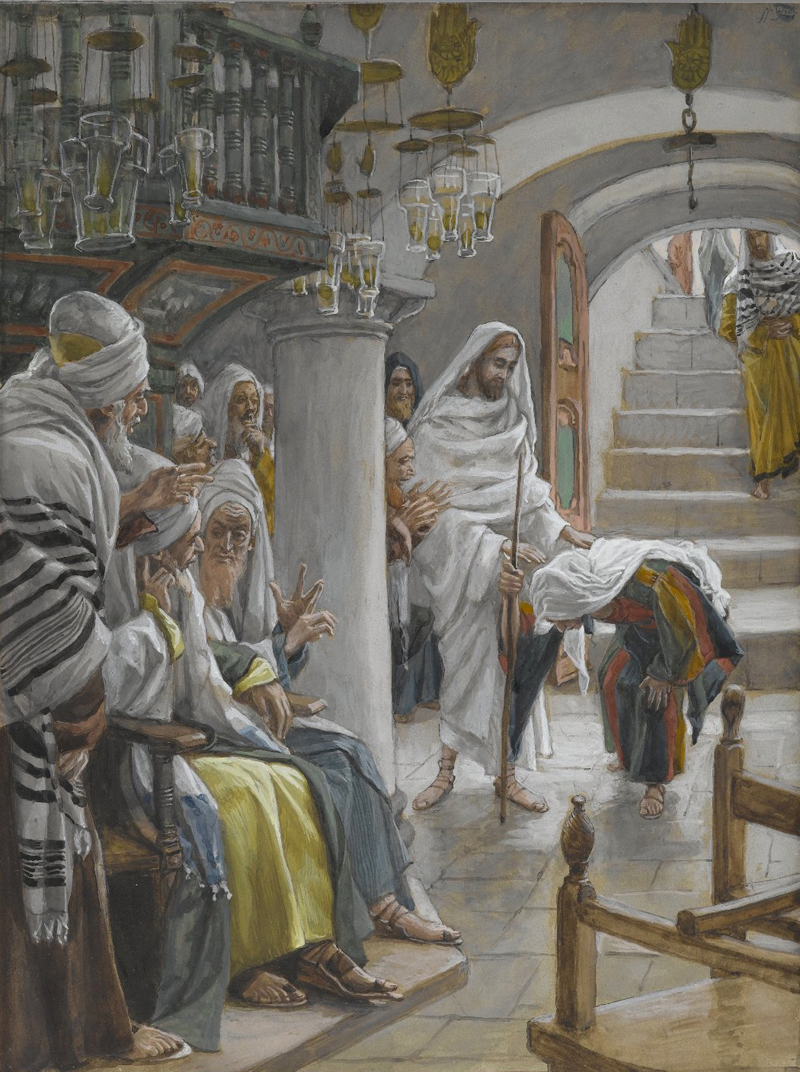
Woman with an Infirmity of Eighteen Years
James Tissot, ~1890
and flow as one to seek the sea,
our kindred hearts and minds unite
to build a church that shall be free —
Free from the bonds that bind the mind
to narrow thought and lifeless creed;
free from a social code that fails
to serve the cause of human need:
A freedom that reveres the past,
but trusts the dawning future more;
and bids the soul, in search of truth,
adventure boldly and explore.
Prophetic church, the future waits
your liberating ministry;
go forward in the power of love,
proclaim the truth that makes us free.
- Marion Franklin Ham, 1867-1956
My dear friends,
In Luke 13:10-17, the compassionate gaze of Jesus falls upon a woman long bowed by suffering. This story is not merely about a miraculous healing, but about liberation—the breaking of spiritual and societal chains. It calls forth the heart of the Bodhisattva path: to behold suffering, to act without delay, and to liberate beings with wisdom and love.
And just then there appeared a woman with a spirit that had crippled her for eighteen years.
She was bent over and was quite unable to stand up straight.
When Jesus saw her, he called her over and said, "Woman, you are set free from your ailment."
When he laid his hands on her, immediately she stood up straight and began praising God.
- Luke 13:10-13
Jesus does not wait for the woman to plead. He sees her—truly sees her—and acts with swift, holy compassion. Here the Christ and the Bodhisattva shine as one: the one who, having awakened, responds spontaneously to suffering. The healing touch of Jesus is not only bodily but existential, lifting her from the burdens of shame, invisibility, and isolation. This is the touch of bodhicitta: compassion infused with wisdom, free from dualistic hesitation.
kept saying to the crowd, "There are six days on which work ought to be done;
come on those days and be cured and not on the Sabbath day."
- Luke 13:14
Rigid clinging to form, devoid of the heart of compassion, is the shadow of spiritual practice. The leader's indignation reveals attachment to the letter of the law over its spirit. In Buddhist terms, this is the downfall of Śīla (ethical discipline) without Prajna (wisdom). The Sabbath was meant to liberate, not to bind. When observance becomes obstruction, the Dharma is no longer alive.
Does not each of you on the sabbath untie his ox or his donkey from the manger,
and lead it away to give it water?
And ought not this woman, a daughter of Abraham whom Satan bound for eighteen long years,
be set free from this bondage on the Sabbath day?"
- Luke 13:15-16
The Lord cuts through delusion with a sharp blade of truth. If we will care for animals on the Sabbath, how can we not care for our fellow human being? Jesus is not breaking the law but revealing its essence. The true Sabbath is not the absence of activity but the presence of holy, liberating action. Compassion is never in conflict with the sacred; it is the most sacred of motivations.
and the entire crowd was rejoicing at all the wonderful things being done by him.
- Luke 13:17
As the Dharma reveals itself, false authorities fall silent, and the people rejoice. Their hearts know truth when they see it. Such is the fruit of the Bodhisattva’s path: not praise for the teacher, but joy in liberation. Let us, too, rejoice not in power or doctrine, but in the wondrous acts of mercy that heal and uplift the lowly.
May we walk in the footsteps of Jesus, our Christ-Bodhisattva, and see the broken ones in our midst. Let us not be hindered by convention or fear, but act with fierce compassion and wisdom. The Sabbath, rightly understood, is the day we set others free, and in so doing, find our own freedom.