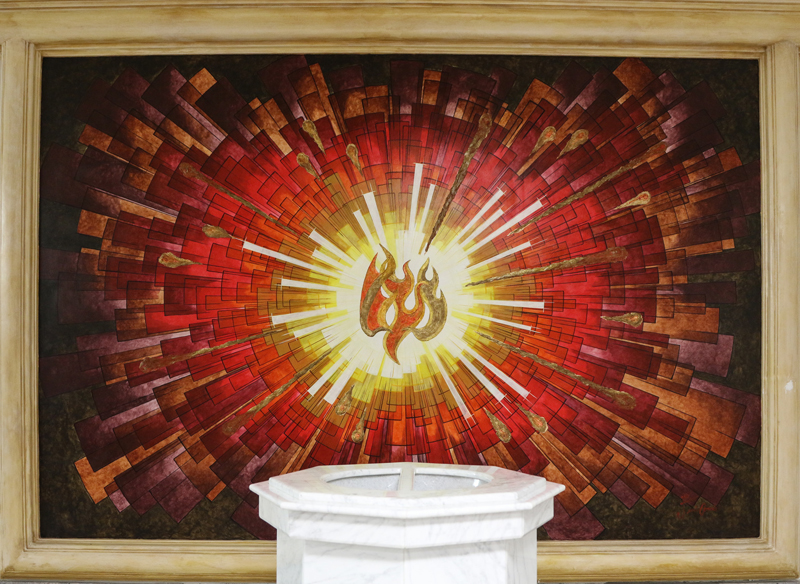
Holy Spirit and Fire with Baptismal Font
Mexicali, México, 20th century
My dear friends,
When we hear the words of Jesus in Luke 12:49-56, we must understand them not only as history, but as living speech directed to the heart of the disciple. In the Bodhisattva path, the voice of Christ is the voice of the Awakened Mind, calling us to abandon complacency, to ignite the lamp of compassion, and to walk steadfastly into the transformation of all beings, beginning with ourselves. This is not a call to comfort, but to a holy urgency.
and how I wish it were already kindled!"
- Luke 12:49
The “fire” is the unquenchable bodhicitta, love and wisdom inseparably united, that burns away self-clinging and illumines the path for all. Jesus longs for this fire to be kindled in every human heart, as a Bodhisattva longs for the awakening of all beings. In the Christian idiom, this fire is the Holy Spirit; in the Mahāyāna understanding, it is the great compassion that cannot rest until the world's darkness is dispelled. Such fire warms and purifies, but it also consumes the illusions we once cherished.
and what constraint I am under until it is completed!"
- Luke 12:50
This “baptism” is the total immersion into suffering for the sake of others. In Christian language, it is the Cross; in the Bodhisattva vow, it is the fearless descent into the ocean of samsara to liberate beings. The “constraint” is the compassion that refuses to turn away, that keeps the Bodhisattva bound to their mission until it is fulfilled. It is the sweet burden of love, freely chosen yet inescapable once the heart has awakened.
No, I tell you, but rather division!"
- Luke 12:51
The peace Christ offers is not the uneasy harmony of unchallenged habits, but the deep peace that comes after the illusions have been torn away. On the Bodhisattva path, the Dharma often divides before it unites, separating us from ignorance, from harmful patterns, from the false securities we cling to. The sword of wisdom cuts sharply, creating a rift between the old self and the new life of awakening. This division is mercy, for without it, we could never be truly free.
they will be divided: father against son and son against father,
mother against daughter and daughter against mother,
mother-in-law against her daughter-in-law and daughter-in-law against mother-in-law."
- Luke 12:52-53
This is not a call to familial hostility, but a recognition that awakening disrupts worldly attachments. In the Bodhisattva’s journey, there are times when the values of compassion, truth, and renunciation will not align with the expectations of those we love. These tensions are a test of steadfastness—will we cling to comfort, or will we follow the way that leads beyond self-concern? True compassion may require us to endure misunderstanding, trusting that the same fire will one day awaken them too.
"When you see a cloud rising in the west, you immediately say, 'It is going to rain'; and so it happens.
And when you see the south wind blowing, you say, 'There will be scorching heat'; and it happens.
You hypocrites! You know how to interpret the appearance of earth and sky,
but why do you not know how to interpret the present time?"
- Luke 12:54-56
We study the skies to predict the weather, but fail to study our own minds to discern the season of the Spirit. A Bodhisattva must learn to read the signs of impermanence and interdependence in each moment. The “present time” is always ripe for awakening, yet we delay, hoping for better conditions. Jesus challenges us to see clearly: the wind of compassion is already blowing, the clouds of impermanence are already gathering—so why do we wait to act for the liberation of all?
My friends, this passage is a summons to urgency. The Bodhisattva-Christ does not come to lull us into complacency, but to ignite a holy fire that will burn through the whole of our being. Let us welcome the baptism of compassion, even if it divides us from old ways, and read the signs of this present moment with awakened eyes. For the time of the Spirit, the time of bodhicitta, is always now.