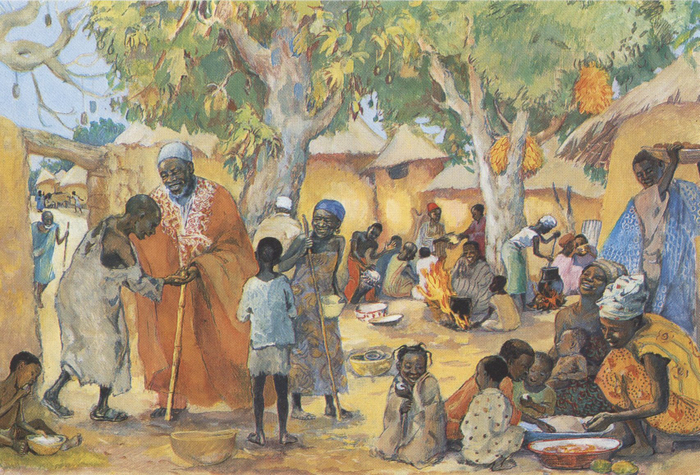
The poor invited to the feast
JESUS MAFA, 1973
My dear friends,
The final verse of Geshe Langri Tangpa's "Eight Verses for Training the Mind" reads:
I will keep these practices undefiled
By the stains of the eight worldly concerns.
And, free from clinging,
I will liberate all beings from bondage
To the unsubdued mind and its karma.
- Geshe Langri Tangpa,
Eight Verses for Training the Mind (8)
The heart of both Geshe Langri Tangpa’s verse and Jesus’ parables in Luke 14 is freedom from attachment to the eight worldly concerns of gain vs. loss, praise vs. blame, fame vs. disgrace, and pleasure vs. pain.
Langri Tangpa says that if we regard all phenomena as illusory, then our practice will remain undefiled by these concerns, and we will be free from clinging. Jesus, in his parables, illustrates exactly how these worldly concerns ensnare the heart.
to eat a meal on the Sabbath, they were watching him closely.
When he noticed how the guests chose the places of honor, he told them a parable.
"When you are invited by someone to a wedding banquet, do not sit down at the place of honor,
in case someone more distinguished than you has been invited by your host,
and the host who invited both of you may come and say to you, 'Give this person your place,'
and then in disgrace you would start to take the lowest place.
But when you are invited, go and sit down at the lowest place,
so that when your host comes, he may say to you, 'Friend, move up higher';
then you will be honored in the presence of all who sit at the table with you.
For all who exalt themselves will be humbled, and those who humble themselves will be exalted."
- Luke 14:1, 7-11
The guests at the Pharisee’s house scramble for seats of honor. This is the worldly concern of fame and disgrace: to be seen as important, to be praised by others, and to avoid humiliation. Jesus points out the folly of this. If you try to exalt yourself, you are vulnerable to disgrace; but if you humble yourself, honor will come naturally.
Langri Tangpa's verse tells us that if one regards the “place of honor” as illusory, just a social convention without inherent reality, then one does not cling to it. Without clinging, the stains of pride, competition, and fear of humiliation cannot defile the mind. One becomes free to act with genuine humility, which is the Bodhisattva’s natural ornament.
"When you give a luncheon or a dinner, do not invite your friends
or your brothers and sisters or your relatives or rich neighbors,
in case they may invite you in return, and you would be repaid.
But when you give a banquet, invite the poor, the crippled, the lame, and the blind.
And you will be blessed because they cannot repay you,
for you will be repaid at the resurrection of the righteous."
- Luke 14:12-14
The host is cautioned against inviting only those who can repay him: friends, relatives, and wealthy neighbors. This is the worldly concern of gain vs. loss. When generosity is tied to reciprocity, it is tainted by self-interest.
Instead, says Jesus, invite those who cannot repay you: the poor, the crippled, the lame, and the blind. This mirrors the Bodhisattva’s practice of giving without expectation, seeing all beings as worthy of compassion, not as instruments of one’s own benefit.
If one regards the very dynamics of social exchange and reciprocity as illusory, then generosity is freed from clinging to reward, praise, or reputation. Giving becomes pure, undefiled by worldly concerns, and aligned with the vow to liberate beings from bondage to karma and self-grasping.
Both teachings converge on this:
- Worldly concerns enslave the mind by making us chase after illusions of status, wealth, and recognition.
- Seeing phenomena as illusory loosens this grasping. When honor and dishonor, gain and loss, are seen as passing mirages, the heart can remain pure.
- Humility and selfless generosity then become natural. They are not strategies for future reward, but spontaneous expressions of bodhicitta, the “Holy Spirit,” the mind of Christ.
Thus, the banquet scene in Luke 14 is a living illustration of Langri Tangpa’s closing verse: those who do not cling to the eight worldly concerns, but instead walk humbly and give freely, walk the path of liberation for themselves and for others.