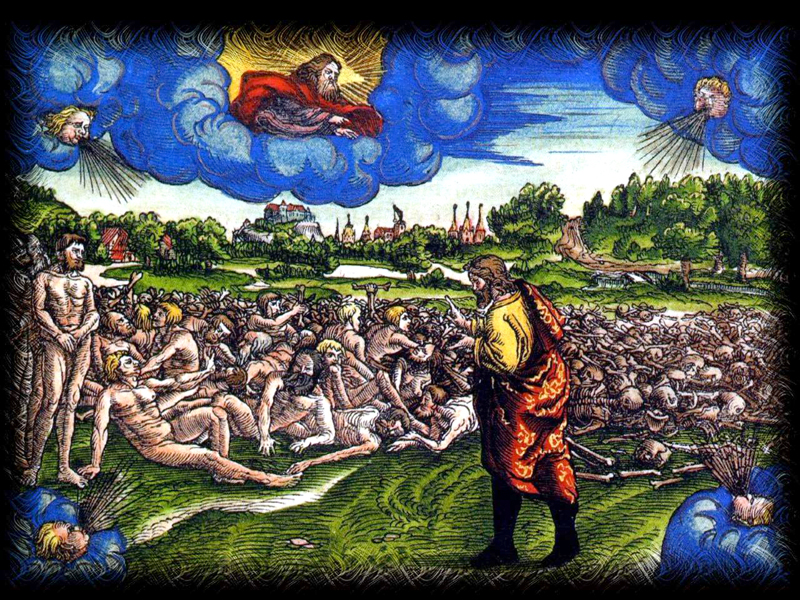
You Shall Live
Lucas Cranach, 1534
My dear friends,
The vision of the prophet Ezekiel in the valley of dry bones is a stark and unsettling image: a landscape of lifelessness, fragmentation, and desolation. Yet from the perspective of the Bodhisattva path, this vision is not merely about restoration after catastrophe; it is a profound simile for the condition of the ordinary mind and the gradual process by which it is awakened. We begin, not as whole and living beings, but as scattered fragments—habits, confusions, and karmic tendencies lying inert. The path does not deny this condition; it begins precisely here, in the valley of what seems beyond hope.
and set me down in the middle of a valley; it was full of bones.
He led me all around them; there were very many lying in the valley, and they were very dry.
He said to me, "Mortal, can these bones live?" I answered, "O Lord GOD, you know."
- Ezekiel 37:1-3
The question, “Can these bones live?” echoes the fundamental doubt that arises at the beginning of the path. Can this confused, distracted, self-centered mind truly awaken? From the standpoint of the Bodhisattva, the answer is not grounded in immediate evidence but in deep trust in Buddha-nature (tathāgatagarbha), the latent capacity for awakening present even in the most desolate conditions. Like Ezekiel, we do not claim certainty based on appearances; we entrust ourselves to a deeper knowing that transformation is possible.
O dry bones, hear the word of the LORD.
Thus says the Lord GOD to these bones:
I will cause breath to enter you, and you shall live.
I will lay sinews on you and will cause flesh to come upon you
and cover you with skin and put breath in you,
and you shall live, and you shall know that I am the LORD."
- Ezekiel 37:4-6
The command to “prophesy” can be understood as the practice of Dharma itself: the deliberate engagement with teachings that speak to what is not yet visible. The Bodhisattva path proceeds through hearing, reflection, and meditation. At first, the words seem external, even abstract. Yet they carry a transformative power. Just as the prophet speaks to bones that cannot hear, we apply teachings to a mind that does not yet fully understand. Still, this is the necessary beginning: aligning intention with truth before realization has fully arisen.
suddenly there was a noise, a rattling, and the bones came together, bone to its bone.
I looked, and there were sinews on them, and flesh had come upon them,
and skin had covered them, but there was no breath in them.
- Ezekiel 37:7-8
This stage corresponds to the initial integration of the path. Ethical discipline, concentration, and understanding begin to take shape. The scattered elements of our life—thoughts, actions, intentions—start to align. There is structure, coherence, even a sense of progress. Yet something essential is still missing. Without the living breath of direct insight and compassion, the path remains incomplete. One may appear spiritually formed, yet still lack the animating realization that brings genuine transformation.
Thus says the Lord GOD: Come from the four winds, O breath,
and breathe upon these slain, that they may live."
I prophesied as he commanded me, and the breath came into them,
and they lived and stood on their feet, a vast multitude.
- Ezekiel 37:9-10
The breath signifies the awakening of bodhicitta, the living heart of the Bodhisattva path. It is not merely understanding, but a profound shift in orientation: the arising of compassion inseparable from wisdom. When this breath enters, practice becomes alive. What was previously constructed becomes animated. The practitioner stands, not as an isolated self striving for attainment, but as part of a vast multitude, interconnected with all beings. The path is no longer about personal development alone; it becomes a participation in universal awakening.
They say, 'Our bones are dried up, and our hope is lost; we are cut off completely.'
Therefore prophesy and say to them: Thus says the Lord GOD:
I am going to open your graves and bring you up from your graves, O my people,
and I will bring you back to the land of Israel.
And you shall know that I am the LORD when I open your graves
and bring you up from your graves, O my people.
- Ezekiel 37:11-13
“Our hope is lost” is the voice of samsaric despair, the deeply ingrained belief that we are fixed in our condition. The Bodhisattva path directly challenges this view. What appears as a grave is, in fact, a temporary configuration of causes and conditions. Through insight into emptiness, we see that no state is permanent, no identity fixed. Thus, resurrection here is not a supernatural exception, but a revelation of the fluid and contingent nature of all phenomena. What is bound can be released; what is dormant can awaken.
then you shall know that I, the LORD, have spoken and will act," says the LORD.
- Ezekiel 37:14
To be “placed on your own soil” suggests stability in realization, the maturation of the path. The practitioner is no longer merely assembling or animating the elements of practice but abiding in a grounded, integrated way of being. Wisdom and compassion function spontaneously. This is not the end of the Bodhisattva path, but its true beginning: a life lived for the benefit of others, rooted in direct realization and sustained by unshakable clarity.
Thus, the valley of dry bones is not only a vision of restoration but a map of transformation. From fragmentation to integration, from structure to living breath, from despair to awakened activity: this is the arc of the Bodhisattva path. What appears lifeless is not devoid of potential. The bones can live, because the very ground of being is dynamic, responsive, and open. The task is to engage the path faithfully, to speak the words of truth even before they are fully realized, and to allow the breath of awakening to enter and enliven all that we are.