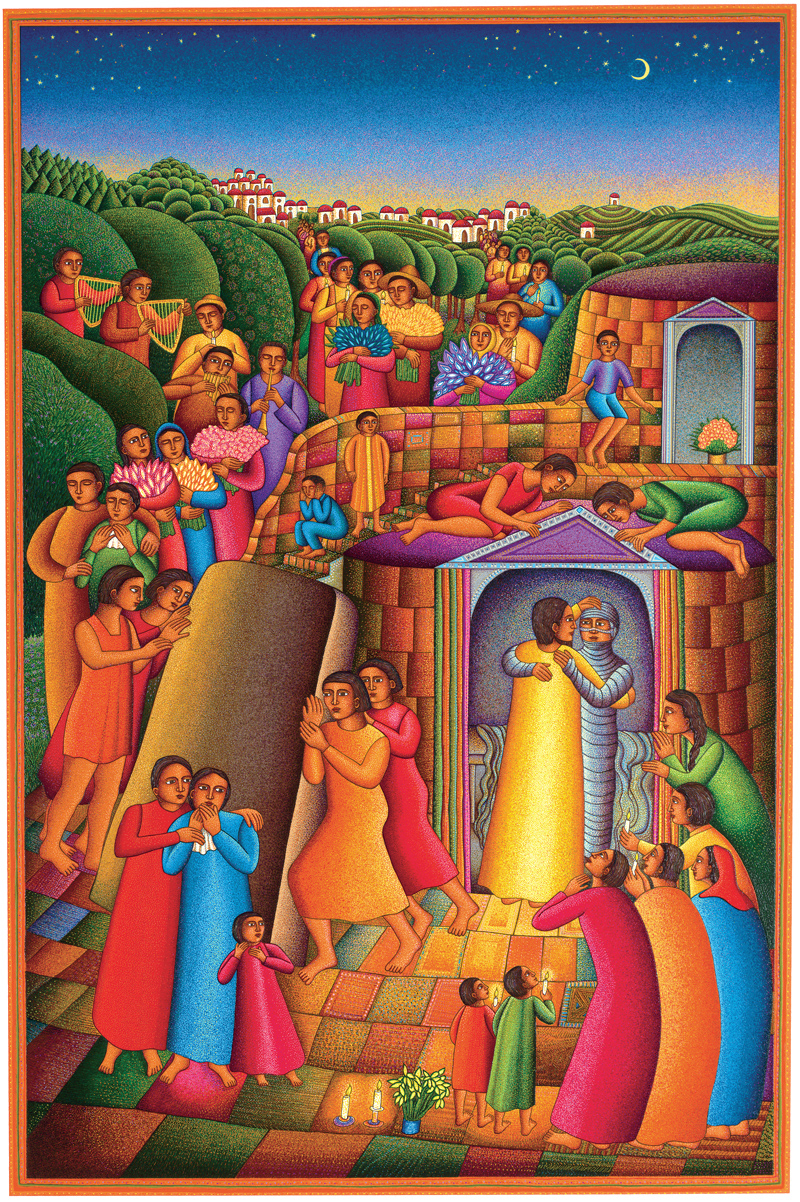
Take Away the Stone
John August Swanson, 2005
My dear friends,
As we approach the threshold of Holy Week, we are invited into a mystery of love that does not turn away from suffering. The raising of Lazarus reveals the awakening heart, a compassion that enters fully into grief, a wisdom that sees beyond death, and a call that summons each of us out of the tombs we inhabit. In this story, we are not merely observers; we are participants in the unfolding of life from death, of light from darkness.
the village of Mary and her sister Martha.
Mary was the one who anointed the Lord with perfume
and wiped his feet with her hair;
her brother Lazarus was ill.
So the sisters sent a message to Jesus,
"Lord, he whom you love is ill."
But when Jesus heard it, he said,
"This illness does not lead to death;
rather, it is for God's glory,
so that the Son of God may be glorified through it."
- John 11:1-4
Love is named at the beginning. "He whom you love is ill." The path begins here, with relationship, with care. Yet even in love, there is suffering. The Bodhisattva does not deny this, but understands that suffering can become the ground of awakening, where the glory of divine compassion is revealed.
after having heard that Lazarus was ill, he stayed two days longer in the place where he was.
Then after this he said to the disciples, "Let us go to Judea again."
The disciples said to him, "Rabbi, the Jews were just now trying to stone you, and are you going there again?"
Jesus answered, "Are there not twelve hours of daylight?
Those who walk during the day do not stumble because they see the light of this world.
But those who walk at night stumble because the light is not in them."
- John 11:5-10
Here we encounter a difficult teaching. Love does not always act immediately. There is a deeper wisdom guiding compassionate action. The delay is not indifference, it is alignment with a greater unfolding. The Bodhisattva learns patience, trusting that the light reveals the right moment to act.
The disciples said to him, "Lord, if he has fallen asleep, he will be all right."
Jesus, however, had been speaking about his death, but they thought that he was referring merely to sleep.
Then Jesus told them plainly, "Lazarus is dead.
For your sake I am glad I was not there, so that you may believe. But let us go to him."
- John 11:11-15
Death is spoken of as sleep. This is the vision of deeper reality, where endings are not final. The awakening mind sees through appearances and understands transformation. Faith grows when we begin to perceive life beyond what is immediately visible.
- John 11:16
There is courage here, though still shadowed by fear. To follow the path of compassion is to risk everything. The disciple senses that love may lead into danger, yet chooses to go. This willingness is the seed of awakening.
Now Bethany was near Jerusalem, some two miles away,
and many of the Jews had come to Martha and Mary to console them about their brother.
When Martha heard that Jesus was coming, she went and met him, while Mary stayed at home.
Martha said to Jesus, "Lord, if you had been here, my brother would not have died.
But even now I know that God will give you whatever you ask of him."
Jesus said to her, "Your brother will rise again."
Martha said to him, "I know that he will rise again in the resurrection on the last day."
Jesus said to her, "I am the resurrection and the life.
Those who believe in me, even though they die, will live,
and everyone who lives and believes in me will never die. Do you believe this?"
She said to him, "Yes, Lord, I believe that you are the Messiah, the Son of God,
the one coming into the world."
- John 11:17-27
Martha stands in the tension between grief and trust. Faith here is not certainty about outcomes, it is confidence in the deeper nature of life. The Bodhisattva learns to stand in this space, where sorrow and trust coexist.
and told her privately, "The Teacher is here and is calling for you."
And when she heard it, she got up quickly and went to him.
- John 11:28-29
The call is personal. Each one is summoned by name. When we hear this call, something in us rises and moves toward life. This is the stirring of awakening within the heart.
The Jews who were with her in the house consoling her saw Mary get up quickly and go out.
They followed her because they thought that she was going to the tomb to weep there.
When Mary came where Jesus was and saw him, she knelt at his feet and said to him,
"Lord, if you had been here, my brother would not have died."
When Jesus saw her weeping and the Jews who came with her also weeping,
he was greatly disturbed in spirit and deeply moved.
He said, "Where have you laid him?" They said to him, "Lord, come and see."
Jesus began to weep.
- John 11:30-35
Here is the heart of compassion. He weeps. This is not weakness, it is the fullness of love. The awakened one does not stand apart from suffering. He enters it completely. In this we see the union of wisdom and compassion.
But some of them said, "Could not he who opened the eyes of the blind man have kept this man from dying?"
- John 11:36-37
Some see love, others question. The same moment reveals different hearts. The path invites us to openness rather than judgment, to trust rather than doubt.
Jesus said, "Take away the stone."
Martha, the sister of the dead man, said to him,
"Lord, already there is a stench because he has been dead four days."
Jesus said to her, "Did I not tell you that if you believed you would see the glory of God?"
- John 11:38-40
"Take away the stone." We are asked to participate. Even when the situation seems beyond hope, we are called to act. The stone represents the barriers we maintain, fear, doubt, resignation. Faith moves them aside.
I knew that you always hear me, but I have said this for the sake of the crowd standing here,
so that they may believe that you sent me."
- John 11:41-42
Gratitude arises before the outcome is visible. This is deep trust in the source of life. The awakened heart rests in this relationship, confident in the unseen.
The dead man came out, his hands and feet bound with strips of cloth and his face wrapped in a cloth
Jesus said to them, "Unbind him, and let him go."
- John 11:43-44
The call goes forth, and life responds. Yet Lazarus emerges still bound. Liberation is both immediate and gradual. The community is invited to participate, to unbind, to free. So it is with us. We awaken, and we continue to be freed together.
- John 11:45
Witnessing transformation opens the heart. Faith grows through encounter. Each moment of awakening becomes a doorway for others.
The voice that called Lazarus calls to you even now. Come out from whatever binds you. Step into the light of compassion and truth. And as you do, help unbind one another, for this is the path of love that leads from death into life.
Hymn: Jesus Calls Us