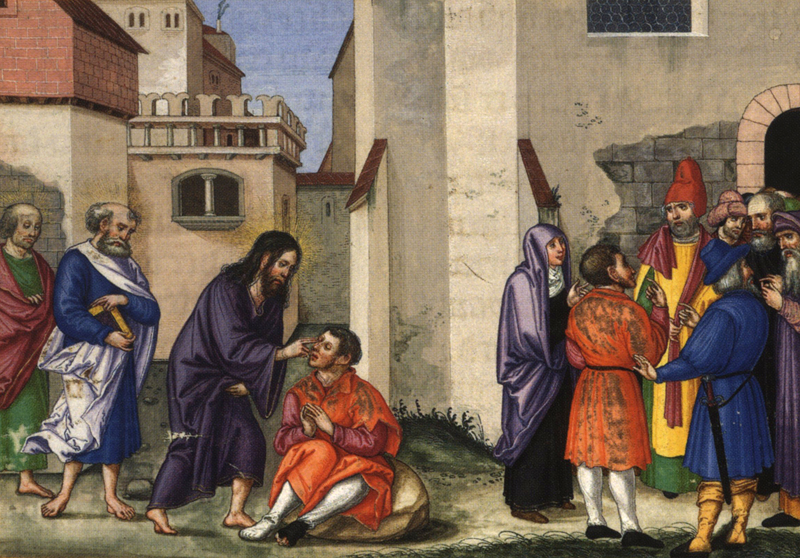
Healing of the Man Born Blind
Matthias Gerung, 1531
My dear friends,
The story of the man born blind reveals the mystery of sight and blindness as it lives within the heart. In the Bodhisattva way, we understand blindness not merely as a physical condition, but as ignorance, avidyā, the deep unknowing that clings to self-regard and separates us from the living truth. Christ, the light of the world, is the living expression of bodhicitta, the awakened mind that sees things as they truly are and responds with boundless compassion. In this passage, we are invited to move from ignorance into seeing, from separation into communion, from fear into liberating love.
His disciples asked him, "Rabbi, who sinned, this man or his parents, that he was born blind?"
Jesus answered, "Neither this man nor his parents sinned;
he was born blind so that God's works might be revealed in him.
We must work the works of him who sent me while it is day; night is coming when no one can work.
As long as I am in the world, I am the light of the world."
- John 9:1-5
The disciples ask about blame, seeking a cause rooted in sin. This reflects the ordinary mind that divides the world into fault and punishment. Yet Jesus redirects them toward a deeper vision. The suffering of the man is not a mark of condemnation, but a field in which the works of God, the awakening of compassion and wisdom, may appear. In the Bodhisattva path, we learn to transform every condition, even suffering, into the path of awakening. The light of Christ shines precisely where ignorance once obscured.
and made mud with the saliva and spread the mud on the man's eyes,
saying to him, "Go, wash in the pool of Siloam" (which means Sent).
Then he went and washed and came back able to see.
- John 9:6-7
The making of mud and the act of anointing reveal something intimate and earthy. Awakening does not descend from afar; it arises through the very elements of our embodied life. The command to wash in Siloam, meaning “Sent,” echoes the path of practice. One must participate, one must go, one must wash. Grace and effort meet here. In Buddhist terms, this is the union of method and wisdom. In Christian language, it is cooperation with grace. The man obeys, and through that trust, his sight opens.
"Is this not the man who used to sit and beg?"
Some were saying, "It is he." Others were saying, "No, but it is someone like him."
He kept saying, "I am he."
- John 9:8-9
Confusion arises among the neighbors. When transformation occurs, the world often hesitates to recognize it. The awakened person may appear the same, yet is fundamentally changed. The man’s simple declaration, “I am he,” echoes the deep recognition of identity transformed. On the Bodhisattva path, one realizes that while the conventional self appears, its nature has shifted toward openness and clarity.
He answered, "The man called Jesus made mud, spread it on my eyes,
and said to me, 'Go to Siloam and wash.'
Then I went and washed and received my sight."
They said to him, "Where is he?" He said, "I do not know."
- John 9:10-12
The man testifies plainly. He does not construct doctrine or argument. He speaks from direct experience. This is the mark of authentic realization. In both the teachings of Christ and the Dharma, lived experience carries a power beyond conceptual elaboration. The simplicity of truth unsettles those who rely only on conceptual certainty.
Now it was a Sabbath day when Jesus made the mud and opened his eyes.
Then the Pharisees also began to ask him how he had received his sight.
He said to them, "He put mud on my eyes. Then I washed, and now I see."
- John 9:13-15
The questioning by the Pharisees introduces attachment to form and rule. The healing occurs on the Sabbath, and thus the focus shifts from liberation to regulation. This mirrors the spiritual danger of clinging to discipline without wisdom. Ethical discipline is essential, yet when grasped rigidly, it obscures compassion. The Bodhisattva keeps discipline as a means to free beings, not as a barrier to their healing.
Others said, "How can a man who is a sinner perform such signs?" And they were divided.
So they said again to the blind man, "What do you say about him? It was your eyes he opened."
He said, "He is a prophet."
- John 9:16-17
Division arises among those who witness the miracle. This reflects the inner division within the unenlightened mind. Part of us recognizes truth, while another part resists it. The healed man moves forward in clarity, declaring Jesus a prophet. His understanding unfolds gradually, showing that awakening often deepens step by step.
until they called the parents of the man who had received his sight and asked them,
"Is this your son, who you say was born blind? How then does he now see?"
His parents answered, "We know that this is our son and that he was born blind,
but we do not know how it is that now he sees, nor do we know who opened his eyes.
Ask him; he is of age. He will speak for himself."
His parents said this because they were afraid of the Pharisees, for the Pharisees had already agreed
that anyone who confessed Jesus to be the Messiah would be put out of the synagogue.
Therefore his parents said, "He is of age; ask him."
- John 9:18-23
Fear binds the parents. Concern for status and security prevents them from speaking fully. This reveals how attachment to social identity constrains truth. On the Bodhisattva path, courage arises from compassion. When one’s motivation is the welfare of all beings, fear begins to loosen its grip.
"Give glory to God! We know that this man is a sinner."
He answered, "I do not know whether he is a sinner.
One thing I do know, that though I was blind, now I see."
- John 9:24-25
The man’s testimony becomes even more refined. “Though I was blind, now I see.” This is the essence of realization. It does not depend on defending a system. It rests in direct knowing. In lojong practice, we are taught to rely on the simple clarity of experience, beyond elaboration.
He answered them, "I have told you already, and you would not listen.
Why do you want to hear it again? Do you also want to become his disciples?"
- John 9:26-27
His response carries a subtle humor and fearlessness. He challenges his questioners, exposing their resistance. This is skillful means. The Bodhisattva sometimes uses unexpected speech to loosen rigid views. Wisdom is not always solemn; it can be sharp, direct, even playful.
We know that God has spoken to Moses, but as for this man, we do not know where he comes from."
The man answered, "Here is an astonishing thing!
You do not know where he comes from, yet he opened my eyes.
We know that God does not listen to sinners,
but he does listen to one who worships him and obeys his will."
- John 9:28-31
The man continues to reason from lived truth. He sees clearly what others refuse to see. Insight naturally gives rise to confidence. This confidence is not arrogance; it is stability grounded in reality. In Buddhist training, this corresponds to the arising of right view.
If this man were not from God, he could do nothing."
They answered him, "You were born entirely in sins, and are you trying to teach us?"
And they drove him out.
- John 9:32-34
Rejection follows. Those attached to their certainty cast him out. This is a familiar pattern. When awakening challenges established identity, it is often resisted. Yet being cast out becomes part of the path. The Bodhisattva accepts loss and exclusion when necessary, holding fast to truth and compassion.
"Do you believe in the Son of Man?"
He answered, "And who is he, sir? Tell me, so that I may believe in him."
Jesus said to him, "You have seen him, and the one speaking with you is he."
He said, "Lord, I believe." And he worshiped him.
- John 9:35-38
Jesus seeks the one who has been cast out. This reveals the heart of compassion. The awakened one does not abandon those rejected by society. The encounter deepens into faith. The man moves from seeing physically to seeing spiritually. He recognizes Christ and bows in reverence. This is the flowering of bodhicitta, where seeing and devotion unite.
so that those who do not see may see and those who do see may become blind."
Some of the Pharisees who were with him heard this and said to him, "Surely we are not blind, are we?"
Jesus said to them, "If you were blind, you would not have sin.
But now that you say, 'We see,' your sin remains.
- John 9:39-41
The final teaching turns the whole narrative inward. Those who think they see remain blind, while those who acknowledge blindness become open to sight. This is the paradox at the heart of both the Gospel and the Dharma. Humility opens the gate to wisdom. Clinging to certainty seals it shut. To walk the Bodhisattva path is to continually relinquish the illusion of knowing, so that true seeing may arise.
Dear friends, let this passage guide your practice. Notice where blindness remains, where assumptions harden into certainty. Offer these places into the light of Christ, into the awakening mind of compassion and wisdom. Walk the path with humility, courage, and love. Then, like the one who was healed, you will come to say with quiet certainty, “I was blind, now I see.” And in that seeing, you will become a light for others.
Amazing Grace