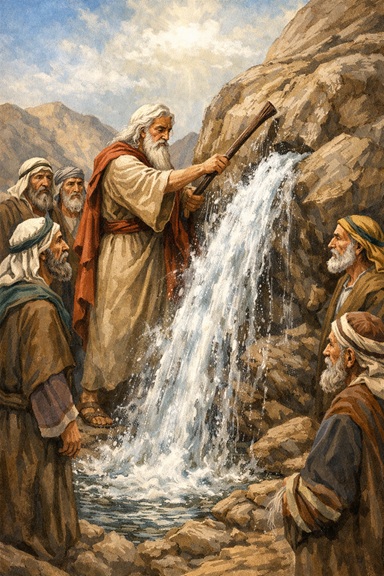
Water From the Rock
Created by ChatGPT-5.3, 2026-03-03.
My dear friends,
In this season of Lent, we are led into the wilderness with Israel, and into the testing ground of the human heart. The Scriptures today speak of thirst, of doubt, and of testing God. They also invite us to reflect on a deeper question: what is the difference between faithless testing and faithful discernment? The wilderness reveals what lives within us. It exposes both our fear and our longing for living water.
the whole congregation of the Israelites
journeyed by stages, as the LORD commanded.
They camped at Rephidim,
but there was no water for the people to drink.
The people quarreled with Moses and said,
"Give us water to drink."
Moses said to them, "Why do you quarrel with me?
Why do you test the LORD?"
But the people thirsted there for water,
and the people complained against Moses and said,
"Why did you bring us out of Egypt,
to kill us and our children and livestock with thirst?"
- Exodus 17:1-3
The people are thirsty, and their thirst becomes accusation. “Why did you bring us out of Egypt?” Beneath the surface complaint lies a deeper wound: “Is the LORD among us or not?” This is not careful inquiry. It is a demand born of fear. They are not seeking understanding; they are demanding proof on their own terms. When anxiety rules the heart, even liberation is reinterpreted as abandonment. This is what Scripture calls “testing the LORD.” It is the posture of distrust that insists reality must conform to our expectations before we will trust.
The LORD said to Moses, "Go on ahead of the people and take some of the elders of Israel with you;
take in your hand the staff with which you struck the Nile and go.
I will be standing there in front of you on the rock at Horeb.
Strike the rock, and water will come out of it, so that the people may drink."
Moses did so, in the sight of the elders of Israel.
- Exodus 17:4-6
Moses does not argue with the people; he turns toward God in prayer. In response, God stands upon the rock at Horeb and commands Moses to strike it. Water flows, not because God was manipulated, but because Moses acted in trust. The rock becomes a sign that divine presence does not depend on our demands. Even in the wilderness, grace is already standing before us.
because the Israelites quarreled and tested the LORD,
saying, "Is the LORD among us or not?"
- Exodus 17:7
Massah means “Test,” and Meribah means “Quarrel.” The place is named after the inner condition of the people. Their question, “Is the LORD among us or not?” reveals the restless mind that oscillates between hope and suspicion. Lent invites us to see our own Massah moments, when we subtly require God to prove Himself. Yet divine faithfulness is not a performance staged for our insecurity. It is a presence that waits for trust to mature.
- Deuteronomy 6:16
“Do not put the LORD your God to the test.” This command protects the covenant relationship. To test God in this sense is to attempt to control the Holy, to demand signs as conditions for obedience. It is the ego’s attempt to reverse roles, placing itself as judge over the Divine. Such testing closes the heart, because it arises from grasping and fear.
saying to him, "If you are the Son of God, throw yourself down,
for it is written, 'He will command his angels concerning you,' and
'On their hands they will bear you up, so that you will not dash your foot against a stone.'"
Jesus said to him, "Again it is written, 'Do not put the Lord your God to the test.'"
- Matthew 4:5-7
When Jesus stands on the pinnacle of the Temple, the tempter invites him to force God’s hand. “Throw yourself down.” It is an invitation to spectacle, to dramatic proof. Jesus answers with Deuteronomy: “Do not put the Lord your God to the test.” He refuses to manipulate the Father for confirmation of his identity. Trust does not require theatrical evidence: The Son does not need to leap in order to know he is held.
by inference, by analogies, by agreement through pondering views, by probability,
or by the thought, 'This contemplative is our teacher.'
When you know for yourselves that, 'These qualities are unskillful;
these qualities are blameworthy; these qualities are criticized by the wise;
these qualities, when adopted and carried out, lead to harm and to suffering'
— then you should abandon them.
When you know for yourselves that, 'These qualities are skillful;
these qualities are blameless; these qualities are praised by the wise;
these qualities, when adopted and carried out, lead to welfare and to happiness'
— then you should enter and remain in them."
Kalama Sutta: To the Kalamas (AN 3.66).
Translated from the Pali by Thanissaro Bhikkhu.
At first glance, the Buddha’s counsel to the Kalamas seems to move in the opposite direction. “Do not go by scripture, tradition, or teacher alone.” Yet this is a different kind of testing. Here the Buddha warns against blind belief. He invites careful discernment: examine whether qualities lead to harm or to welfare. This is not the testing of defiance, but the testing of wisdom. It is an inward investigation of greed, hatred, and delusion. In this sense, both traditions guard the heart. Scripture forbids manipulative challenge toward God. The Buddha forbids unexamined submission to authority. Together they call us into mature spiritual responsibility.
The reconciliation lies here: do not test God out of distrust; do test your own mind out of sincerity. Do not demand signs in order to believe; do examine whether your beliefs produce compassion and truth. The wilderness exposes our thirst, yet it also reveals the rock that stands before us. When questioning arises from humility and love, it becomes discernment. When it arises from fear and grasping, it becomes rebellion. Lent invites us to move from Massah to mature trust, from quarrel to quiet confidence. The living water flows where trust and wisdom meet.