The Three Principles of the Path
And to give birth to the great wish for blissful freedom.
The Foundation of All Perfections
Joni Mitchell, "The Circle Game" (1970)
the eye is not satisfied with seeing, or the ear filled with hearing.
What has been is what will be, and what has been done is what will be done;
there is nothing new under the sun.
-- Ecclesiastes 1:8-9
This is a navigable map.
Click on an area to navigate to its documentation (if any).
My dear friends,
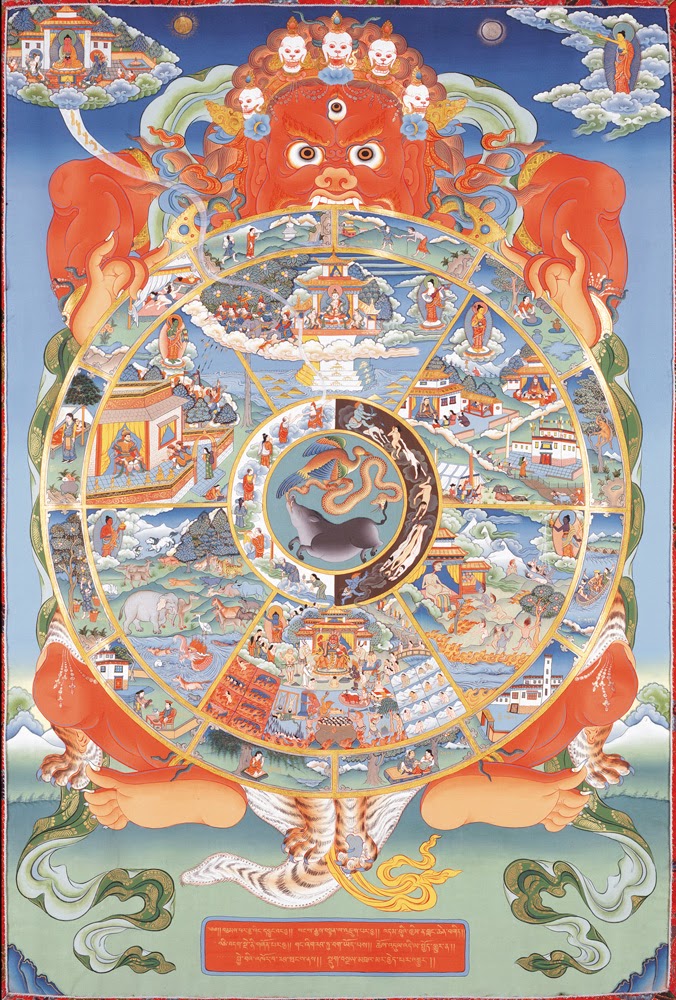
In the previous lesson, we reflected on the failings of worldly existence: gain and loss, praise and blame, pleasure and pain, fame and obscurity. We saw that worldly satisfactions are unstable and unable to provide lasting fulfillment. The traditional Buddhist image that illustrates this truth is the Bhavachakra, the Wheel of Becoming. At first glance it appears to be a map of rebirth in different worlds. More profoundly, it is a mirror held up to our own minds. It reveals the habits, emotions, and delusions that keep beings circling endlessly through dissatisfaction. By studying this wheel, we begin to understand why the Buddha encouraged us to seek freedom rather than better accommodations within the cycle.
A Map of the Mind
The six realms shown in the wheel can be understood as literal modes of rebirth, but they can also be understood psychologically. We move through them every day. Sometimes we are consumed by anger and inhabit a hell realm. Sometimes we are driven by insatiable craving and live as hungry ghosts. At other times we act from confusion, jealousy, ambition, or complacency. The wheel therefore depicts not merely where beings are born, but how beings experience life whenever the mind is ruled by ignorance.
The purpose of contemplating the wheel is not to frighten us, but to awaken wisdom. When we recognize these patterns in ourselves, we become less fascinated by them. We begin to see that no position within the wheel, however pleasant, offers permanent security. This insight gives rise to renunciation: not a rejection of life, but a determination to seek something more reliable than the endless pursuit of temporary satisfactions.
The Hell Realm: The World of Hatred, Anger and Violence
The hell realm(*) represents the experience of intense anger, hatred, resentment, and violence. When consumed by rage, we create a world of suffering for ourselves and others. Even before any outward action is taken, the mind itself becomes a prison of fire and torment.
Many people have experienced moments when anger dominated their awareness so completely that they could think of nothing else. During such times, the world appears hostile, threatening, and deserving of punishment. The lesson of the hell realm is that hatred never brings lasting relief. It only perpetuates further suffering.
The Hungry Ghost Realm: The World of Craving
Hungry ghosts (pretas) are traditionally depicted with enormous stomachs and tiny throats. Their hunger is immense, but they cannot consume enough to satisfy it. This symbolizes craving: the belief that one more possession, one more pleasure, one more success will finally make us content.
Modern society often encourages this state of mind. Advertising constantly tells us that happiness lies in acquiring something new. Yet desire fulfilled quickly becomes desire renewed. The hungry ghost realm reminds us that craving grows by feeding upon itself.
The Animal Realm: The World of Ignorance and Pain
The animal realm is marked by both suffering and limited awareness. Animals live in a world governed by hunger, fear, injury, disease, competition, and predation. Every day is shaped by the struggle to find food, avoid danger, protect territory, and survive. Even moments of safety are uncertain, for stronger animals may appear, resources may disappear, or sickness may strike without warning.
At the same time, animals lack the freedom and understanding needed to reflect deeply upon their condition. They act largely through instinct and habit, responding to immediate needs rather than seeking lasting solutions to suffering. Human beings can fall into a similar pattern whenever life becomes focused entirely on consumption, entertainment, routine, and self-protection, without questioning the deeper causes of happiness and unhappiness.
This realm therefore illustrates both pain and ignorance. Suffering is abundant, yet the wisdom needed to escape it is difficult to develop. The precious opportunity of human life lies in our ability not only to experience suffering, but also to learn from it, question our assumptions, and seek a path beyond it.
The Asura Realm: The World of Jealousy
The asuras, or titans, possess great power and privilege, yet they are consumed by envy. Their attention is fixed on what others possess rather than on what they themselves have.
This realm is visible wherever life becomes a contest of status, achievement, and comparison. Even success cannot bring peace if the mind constantly measures itself against others. Jealous competition turns abundance into dissatisfaction and friendship into rivalry.
The God Realm: The World of Luxury
The god realm appears at first to be the most desirable. The devas enjoy pleasure, beauty, power, and long life. Yet they are not free. Their good fortune eventually comes to an end, and because they have become accustomed to comfort, they are often unprepared for its loss.
This realm illustrates an important truth: pleasure by itself does not produce wisdom. Indeed, excessive comfort can become an obstacle when it discourages serious reflection on the nature of life. The gods remain within samsara because even heavenly experiences are impermanent.
The 3 Poisons: The Engine of Samsara
At the center of the wheel are a rooster, a snake, and a pig. These symbolize craving, aversion, and ignorance. They are called the Three Poisons because they contaminate every experience and generate all the other forms of suffering depicted in the wheel.
Whenever we cling to what we like, reject what we dislike, or fail to see reality clearly, the wheel continues to turn. The various realms are simply different expressions of these same underlying tendencies. To uproot the Three Poisons is therefore to strike at the very engine that drives samsara.
The Lord of Death
The entire Wheel of Existence is shown in the grip of Yama, the Lord of Death. Yama symbolizes the universal law of impermanence: everything that arises will eventually pass away, including the five skandhas that comprise our personality, represented as skulls in Yama's crown. Every realm within the wheel is subject to birth, aging, sickness, and death. The pleasures of the god realms fade. Human achievements vanish. Even the longest-lived beings eventually exhaust the causes that support their existence. No condition within samsara can provide lasting security.
Yet the image teaches more than the inevitability of physical death. Yama also reminds us that all experiences shaped by ignorance, attachment, and aversion are inherently unstable. As long as the Three Poisons remain at the center of our lives, we continue to move from one unsatisfactory state to another, regardless of the realm in which we find ourselves.
The Human Realm: The World of Opportunity
Against this backdrop, the human realm occupies a unique position within the wheel. Human beings experience enough suffering to recognize the shortcomings of samsara, yet enough freedom, intelligence, and opportunity to seek a path beyond it. For this reason Buddhist teachings repeatedly praise human birth as precious and difficult to obtain. It is here that we can hear the Dharma, reflect upon it, and put it into practice.
For this reason the Buddha is depicted outside the wheel, pointing toward the moon of liberation. He does not point to another realm within samsara, but to a transformation of heart and mind. Liberation begins when we recognize the causes of suffering and undertake the path that weakens and ultimately uproots the Three Poisons. The purpose of contemplating the wheel is therefore not to reject the world, but to transform our relationship to it. Rather than being driven by ignorance, attachment, and aversion, we learn to cultivate wisdom, compassion, and ethical conduct.
For followers of the Mahayana, liberation is not a matter of escaping samsara and abandoning those who remain behind. Inspired by bodhicitta, the awakening mind, we seek freedom from the Three Poisons so that we may help others do the same. Like the Buddha depicted outside the wheel, we learn to point beyond confusion and suffering toward wisdom and compassion.
Thus the Wheel of Existence serves both as a warning and as an invitation. It reveals the consequences of ignorance and attachment, but it also shows the possibility of awakening. By understanding the causes of suffering and following the path taught by the Buddha and Jesus, we can live in the world without being ruled by the forces that keep the wheel turning.
(*) Detailed, Dantesque descriptions of multiple hell realms can be found in verses 76-87 of Nagarjuna's Letter to a Friend and in sections 152-164 of Pabongka Rinpoche's Liberation in the Palm of Your Hand.