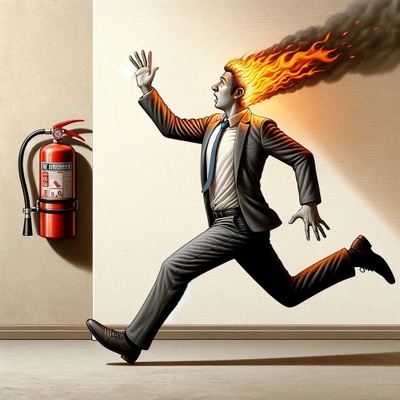
Head on Fire
ChatGPT-4/DALL-E3, 2023-12-16
the Blessed One was staying near Nadika
in the Brick Hall.
There he addressed the monks,
"...how is mindfulness of death
developed and pursued
so that it is of great fruit and great benefit?"
- Maranassati Sutta (2) (AN 6.20).
Translated from the Pali by Thanissaro Bhikkhu.
(edited for length and comprehension)
My dear friends,
The Four Thoughts that Turn the Mind to the Dharma awaken us from spiritual sleep. We have reflected on the precious opportunity of this human life, its impermanence, the certainty that our actions bear fruit, and the unsatisfactory nature of cyclic existence. These contemplations are meant to fill us with a wise urgency. The Buddha encourages us to remember death frequently, because the awareness that life is uncertain transforms vague good intentions into wholehearted practice.
or as night departs and day returns, you reflect:
'Many are the (possible) causes of my death...'"
- Maranassati Sutta
The Buddha begins with a simple exercise. At the turning of day into night, and night into day, we remember that death may come at any time. Rather than being gloomy or fearful, this reflection can restore perspective. When we remember that every meeting may be our last, resentment becomes difficult to justify, worldly ambitions lose some of their enchantment, and kindness becomes far more precious.
that would cause me great regret, were I to die in the night or day?'
If, on reflecting, you realize that there remain any evil, unskillful qualities
that would cause you great regret, were you to die in the night or day, then you should
put forth extra desire, effort, diligence, endeavor, relentlessness, mindfulness, and alertness
for the abandoning of those very same evil, unskillful qualities."
extra desire, effort, diligence, endeavor, relentlessness, mindfulness, and alertness
to put out the fire on their turban or head, in the same way you should put forth
extra desire, effort, diligence, endeavor, relentlessness, mindfulness,and alertness
for the abandoning of those very same evil, unskillful qualities...."
- Maranassati Sutta
The image of a person whose head is on fire is intentionally startling. Someone in that condition would postpone every lesser concern until the flames were extinguished. In the same spirit, we are urged to recognize greed, hatred, pride, jealousy, and self-centeredness as the true emergency. These habits accompany us continually unless they are abandoned through ethical discipline, meditation, wisdom, and the cultivation of great compassion. Mindfulness of death therefore becomes a powerful ally, continually reminding us to practice while the opportunity remains.
that would be a hindrance for you were you to die in the night or day,
then for that very reason you should dwell in joy and rapture,
training yourself day and night in skillful qualities.
This is how mindfulness of death is developed and pursued
so that it is of great fruit and great benefit...."
That is what the Blessed One said.
Gratified, the monks delighted in the Blessed One's words.
- Maranassati Sutta
Precious human life, gained but once,
Has great potential but is easily lost.
Inspire me to remember this constantly
And to think day and night of taking its essence.
- The Foundation of All Perfections, Verse 2
Relying upon the boat of this human life,
Free yourself from the great river of pain!
As it is hard to find this boat again,
This is no time for sleep, you fool.
- Shantideva, Bodhisattvacharyavatara, VII(14)
So teach us to count our days
that we may gain a wise heart.
- Psalm 90:12
The Buddha does not leave us with anxiety about death. When we discover that our heart is becoming freer from resentment, craving, and delusion, mindfulness of death ripens into gratitude and confidence. We rejoice, not because our work is finished, but because the path is bearing fruit. Such joy nourishes diligence. Every day becomes another opportunity to deepen wisdom, strengthen compassion, and dedicate this precious human life to the welfare of all beings.
Mindfulness of death gives rise to a sense of spiritual urgency, yet urgency alone is insufficient. Fire can illuminate or destroy, depending on how it is directed. If our determination hardens into harshness toward ourselves or others, we have exchanged one form of delusion for another. Therefore, we will next consider Buddha's Middle Path: a way of wholehearted effort guided by wisdom, free from both indulgence and self-punishment. With our priorities now clarified, we are ready to learn how to practice with unwavering diligence and balance.