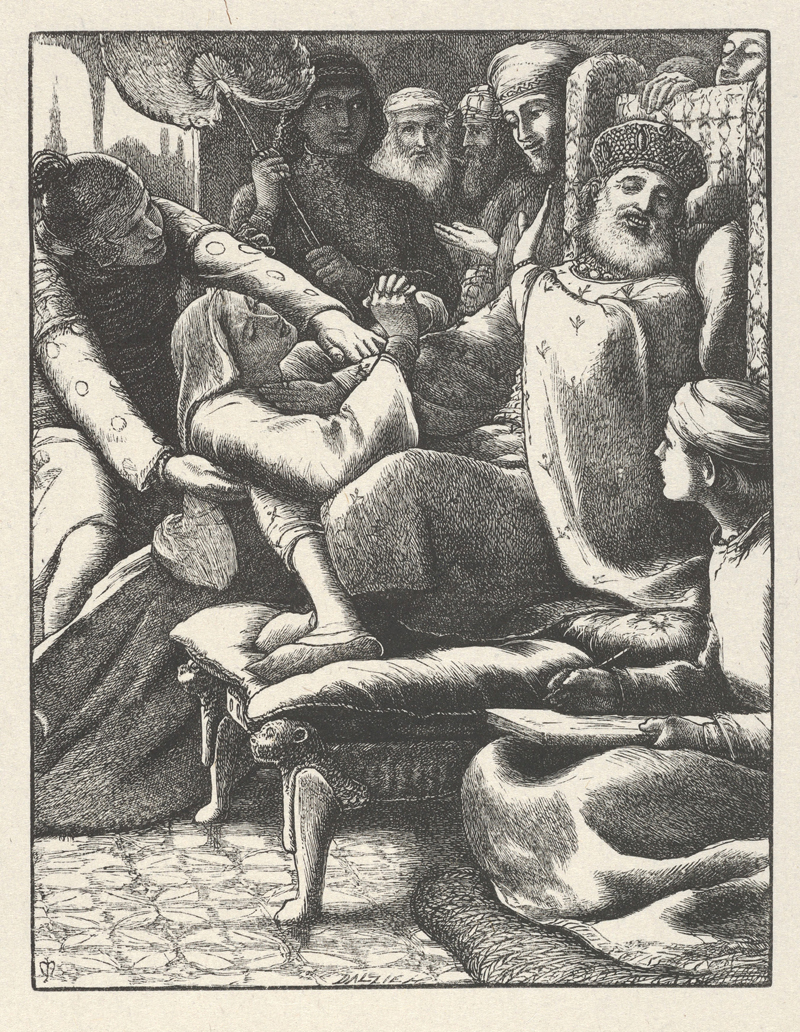
Unjust Judge and the Importunate Widow
John Everett Millais, 1864
A Conqueror's child must never waver;
Always should one exert oneself
To never stray from one's practice.
- Shantideva, Bodhisattvacharyavatara, IV(1)
My dear friends,
The parable of the Unjust Judge and the Importunate Widow teaches us, through the skillful means of Jesus, the transformative power of steadfast, heartfelt prayer. For the Bodhisattva who has awakened bodhicitta, the mind of love and compassion, this parable becomes a mirror reflecting the necessity of tireless effort on the path of awakening. It is not a tale of divine whim, but of the unwavering perseverance that removes all obscurations from the mind, much like the widow's persistence wears down resistance. Let us examine this teaching in the light of the path to Buddhahood, where unshakable resolve and limitless compassion meet.
to pray always and not to lose heart.
- Luke 18:1
This exhortation to pray always is the very counsel of lojong, the mind-training teachings, where we are instructed to practice in all situations and not to be disheartened when the mind is dull or the world appears deaf to our cries. Prayer, here, is not merely petition but the sincere, continuous aspiration that all beings be free from suffering. To not lose heart is to keep the lamp of bodhicitta burning even when winds of adversity blow fiercely.
who neither feared God nor had respect for people."
- Luke 18:2
The unjust judge symbolizes the nature of worldly power untempered by compassion or wisdom. Such a one reflects the deluded state of the egoic mind, which neither reveres the divine nor sees the other as sacred. Yet even such a mind, rigid and self-involved, can be moved, not through argument or condemnation, but by the power of relentless, loving persistence.
'Grant me justice against my accuser.'"
- Luke 18:3
The widow represents the Bodhisattva spirit, a vulnerable one in worldly terms, yet unyielding in compassionate resolve. Her cry for justice is the cry of all beings under the weight of delusion and suffering. She does not retaliate or fall into despair. She returns again and again.
'Though I have no fear of God and no respect for anyone, yet because this widow keeps bothering me,
I will grant her justice, so that she may not wear me out by continually coming.'"
- Luke 18:4-5
Even the hardened heart, through the constant presence of compassion’s plea, begins to soften. This is the mystery of grace and the power of virtuous repetition. In the Bodhisattva path, we return from bliss to the world again and again, not because the world is welcoming, but because our vow is deep.
And will not God grant justice to his chosen ones who cry to him day and night?
Will he delay long in helping them? I tell you, he will quickly grant justice to them."
- Luke 18:6-8a
Here Jesus reveals the deep truth: the Divine is not deaf. The Bodhicitta we offer in prayer and practice aligns with the very mind of God, the ever-present force of compassionate wisdom. Though the fruition may not appear according to our calendar, the energy of persistent love hastens the arrival of justice. This is not the justice of retribution, but the justice of liberation for all beings.
- Luke 18:8b
Faith, in the Bodhisattva sense, is the courage to remain open-hearted in a world that often seems unmoved by love. When the end comes, will we be found to be practitioners whose faith is not in outer reward, but in the inner certainty of love’s triumph? This parable exhorts us to be that faith: to persevere, to return again and again for the sake of others, until all are free.
Therefore, my dear friends, take heart. Do not weary in well-doing. Let the widow be your teacher, for she shows the path of patient endurance and boundless compassion. And may we, through the mind of awakening, the prayer that never ceases, become instruments of divine justice, until even the unjust are transformed by the persistence of love.