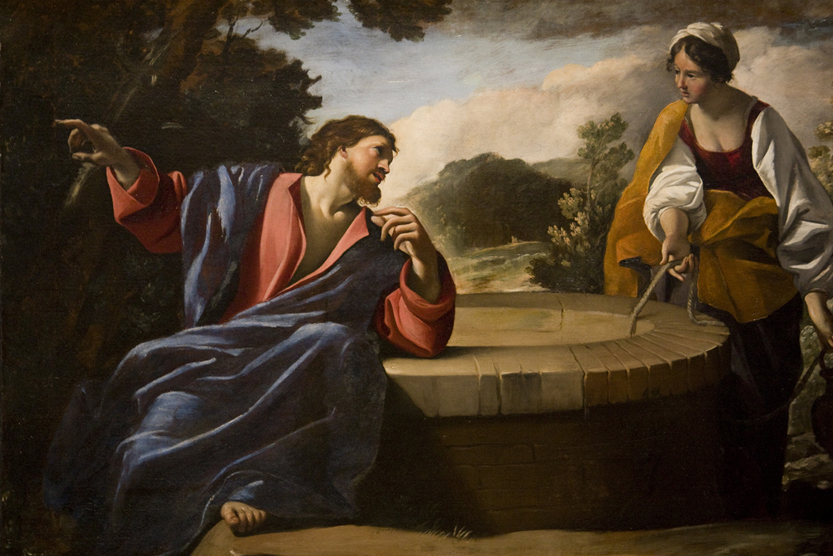
Christ and the Samaritan Woman
Santa Sabina, Rome
My dear friends,
On this Third Sunday in Lent, the Church leads us to the well at noon, to the hour of heat and exposure. In the season of purification and illumination, we are invited to sit beside Christ at the place of our thirst. The journey of the Samaritan woman is the journey of every seeker on the Bodhisattva path: from habitual craving to awakened compassion, from isolation to communion, from confusion to living wisdom. Here at the well, the mind of Christ, which we may understand as bodhicitta, meets the restless heart and reveals a spring that does not run dry.
Jacob's well was there, and Jesus, tired out by his journey, was sitting by the well. It was about noon.
A Samaritan woman came to draw water, and Jesus said to her, "Give me a drink."
(His disciples had gone to the city to buy food.)
The Samaritan woman said to him, "How is it that you, a Jew, ask a drink of me, a woman of Samaria?"
(Jews do not share things in common with Samaritans.)
- John 4:5-9
The Lord appears weary. He sits, vulnerable, asking for water. This is the humility of the Bodhisattva, who does not remain aloof from suffering beings but enters their terrain. The boundaries between Jew and Samaritan, man and woman, pure and impure, mirror the dualistic mind that divides self and other. When Jesus says, "Give me a drink," he invites relationship. Compassion begins when we dare to cross the lines drawn by fear. In Lent, we are asked to see where we still refuse to share the well.
you would have asked him, and he would have given you living water."
The woman said to him, "Sir, you have no bucket, and the well is deep. Where do you get that living water?
Are you greater than our ancestor Jacob, who gave us the well,and with his sons and his flocks drank from it?"
Jesus said to her, "Everyone who drinks of this water will be thirsty again,
but those who drink of the water that I will give them will never be thirsty.
The water that I will give will become in them a spring of water gushing up to eternal life."
- John 4:10-14
The woman hears only literal water. So often we cling to the bucket of concepts, measuring grace by what we can lower into the well. The living water is the gift of awakened mind, the inexhaustible compassion and wisdom that arise when self grasping loosens. All conditioned satisfactions leave us thirsty again. The water Christ offers becomes an inner spring, like bodhicitta, flowing outward for the life of the world. Eternal life is not mere duration; it is participation in the boundless life of God here and now.
so that I may never be thirsty or have to keep coming here to draw water."
Jesus said to her, "Go, call your husband, and come back."
The woman answered him, "I have no husband."
Jesus said to her, "You are right in saying, 'I have no husband,'
for you have had five husbands,
and the one you have now is not your husband.
What you have said is true!"
- John 4:15-18
The path turns toward truth. Before the spring flows freely, the hidden patterns of craving must be revealed. Jesus names her history without condemnation. This is the gaze of wisdom, clear and compassionate. On the Bodhisattva path, confession is not humiliation; it is liberation from illusion. When we allow Christ to illuminate our tangled attachments, shame gives way to honesty, and honesty becomes the doorway to transformation.
Our ancestors worshiped on this mountain,
but you say that the place where people must worship is in Jerusalem."
Jesus said to her, "Woman, believe me, the hour is coming
when you will worship the Father neither on this mountain nor in Jerusalem.
You worship what you do not know; we worship what we know, for salvation is from the Jews.
But the hour is coming and is now here
when the true worshipers will worship the Father in spirit and truth,
for the Father seeks such as these to worship him.
God is spirit, and those who worship him must worship in spirit and truth."
- John 4:19-24
The conversation rises from personal history to ultimate concern. Where is the true mountain? The Lord points beyond geography to interior awakening. To worship in spirit and truth is to abide in the Holy Spirit, the living current of divine love, and to see reality as it is. In Buddhist language, this is the union of compassion and emptiness. When the heart is freed from fixation, every place becomes holy ground. The Father seeks those whose prayer flows from awakened awareness.
"When he comes, he will proclaim all things to us."
Jesus said to her, "I am he, the one who is speaking to you."
- John 4:25-26
Here the revelation is direct. "I am he." The great I AM speaks to one considered an outsider. Awakening does not belong to an elite. The Messiah stands before her as living presence. In contemplative practice, there comes a moment when the truth we awaited is discovered as already here, speaking within our own awareness. The seeker and the Sought meet in simplicity.
but no one said, "What do you want?" or, "Why are you speaking with her?"
- John 4:27
The disciples are astonished. Their silence reveals how strong habitual structures can be. The Bodhisattva gently unsettles conventions that exclude and diminish. Lent asks us to examine the quiet judgments we carry. Are we surprised by grace when it crosses our expectations?
"Come and see a man who told me everything I have ever done!
He cannot be the Messiah, can he?"
They left the city and were on their way to him.
- John 4:28-30
She leaves her jar. The symbol of repetitive thirst is set aside. Having tasted living water, she becomes a messenger. This is the flowering of bodhicitta. Personal encounter ripens into compassionate action. She does not preach doctrine; she invites, "Come and see." Authentic realization naturally turns outward for the benefit of others.
But he said to them, "I have food to eat that you do not know about."
So the disciples said to one another, "Surely no one has brought him something to eat?"
Jesus said to them, "My food is to do the will of him who sent me and to complete his work."
- John 4:31-34
Christ is nourished by alignment with the Father's will. For the awakened one, compassionate activity is sustenance. When our practice matures, serving others ceases to feel like depletion and becomes deep nourishment. The will of God is that all may awaken to love.
But I tell you, look around you, and see how the fields are ripe for harvesting.
The reaper is already receiving wages and is gathering fruit for eternal life,
so that sower and reaper may rejoice together.
For here the saying holds true, 'One sows and another reaps.'
I sent you to reap that for which you did not labor.
Others have labored, and you have entered into their labor."
- John 4:35-38
The harvest is present. The ripening of hearts may be hidden from us, yet the Lord sees readiness. On the Bodhisattva path, we trust that seeds planted by countless acts of kindness will bear fruit in their time. Sower and reaper rejoice together, for all awakening is interconnected. We participate in a vast field of grace that precedes and exceeds us.
"He told me everything I have ever done."
So when the Samaritans came to him, they asked him to stay with them,
and he stayed there two days. And many more believed because of his word.
They said to the woman, "It is no longer because of what you said that we believe,
for we have heard for ourselves, and we know that this is truly the Savior of the world."
- John 4:39-42
The testimony of one wounded and awakened heart becomes the doorway for many. At first they believe because of her word. This is how the path often begins, through the borrowed light of another's faith. Yet the Lord does not leave them dependent. He abides with them, and in that shared presence their trust matures into direct knowing. "We have heard him ourselves." This is the movement from hearsay to realization, from concept to encounter.
Notice the title they proclaim: "the Christ, the Saviour of the world." The circle widens beyond tribe and boundary. Samaritans confess a Jewish Messiah as Saviour of the world. Here the Bodhisattva heart is revealed in its fullness. Salvation is not the possession of a few; it is the liberation of all beings. The awakened one remains, abides, and offers living water without discrimination.
My dear friends, during this Lenten season let us approach the well with courage. Let us allow Christ to name our thirst, to uncover our attachments, and to awaken within us the spring of living water. Then, leaving behind our jars of repetitive craving, may we become humble witnesses. May we worship in spirit and in truth. May the mind of Christ, the radiant bodhicitta of self giving love, flow through us for the healing of the world.