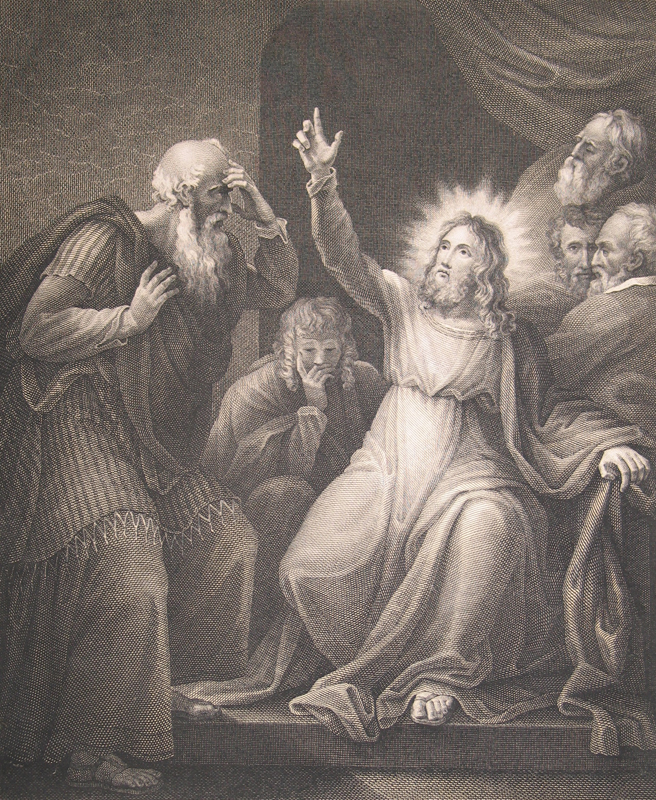
Nicodemus Came to Jesus by Night
The Macklin Bible, 1800
My dear friends,
On this Second Sunday in Lent, we are invited into the quiet night where Nicodemus seeks the Lord. Lent is the season of turning the mind toward awakening, of allowing the old self fashioned by habit and fear to soften under the gaze of divine love. In the Bodhisattva path, this turning is called the arousing of bodhicitta, the Awakening Mind that longs for the liberation of all beings. In this dialogue, we witness the stirring of that very mind within a sincere seeker who comes in darkness, yet is drawn by light.
named Nicodemus, a ruler of the Jews:
The same came to Jesus by night, and said unto him,
Rabbi, we know that thou art a teacher come from God:
for no man can do these miracles that thou doest,
except God be with him.
- John 3:1-2
Nicodemus comes by night. Night represents the unexamined patterns of the conditioned mind, the subtle clinging to status, certainty, and self. Yet he comes. This is already grace at work. On the Bodhisattva path, we do not despise our darkness; we bring it into dialogue with wisdom. Nicodemus honors Jesus as a teacher sent from God. In this humility, the seed of awakening is planted. When we recognize authentic spiritual authority, when we admit that we do not see clearly, the heart begins to open.
Except a man be born again, he cannot see the kingdom of God.
Nicodemus saith unto him, How can a man be born when he is old?
can he enter the second time into his mother's womb, and be born?
- John 3:3-4
To be born again is to allow the mind to be reshaped by ultimate truth. In the language of the Dharma, it is to realize emptiness and interbeing, to see that the self we defend so fiercely is a construction. Nicodemus interprets the teaching literally, as many of us do when confronted with mystery. We imagine change as a rearrangement of old forms, yet Jesus speaks of a radical reorientation of consciousness. Lent calls us into this rebirth, into a life grounded in Spirit rather than ego.
Except a man be born of water and of the Spirit, he cannot enter into the kingdom of God.
That which is born of the flesh is flesh; and that which is born of the Spirit is spirit.
- John 3:5-6
Water cleanses and Spirit enlivens. Water is like ethical discipline, washing the coarse obscurations of harmful action. Spirit is like meditative concentration and wisdom, infusing the heart with direct knowing. Flesh gives rise to further grasping when left untended; Spirit awakens compassion and clarity. When we consent to purification and illumination, the Holy Spirit, the mind of Christ, flowers within us as bodhicitta. Then our actions begin to benefit others spontaneously.
The wind bloweth where it listeth, and thou hearest the sound thereof,
but canst not tell whence it cometh, and whither it goeth:
so is every one that is born of the Spirit.
- John 3:7-8
The wind is unseen, yet its effects are evident. So it is with the transformation of the heart. On the contemplative path, we may not grasp how grace operates, yet we begin to notice patience where there was anger, generosity where there was fear. The Spirit moves freely, beyond our attempts to control it. When we surrender self-clinging, we become vessels through which compassion flows for the sake of the world.
Jesus answered and said unto him, Art thou a master of Israel, and knowest not these things?
Verily, verily, I say unto thee,
We speak that we do know, and testify that we have seen; and ye receive not our witness.
If I have told you earthly things, and ye believe not, how shall ye believe, if I tell you of heavenly things?
- John 3:9-12
The teacher speaks from realization. In the Bodhisattva tradition, authentic instruction arises from direct insight into emptiness and compassion united. Jesus gently challenges Nicodemus to move beyond conceptual mastery into lived understanding. Heavenly things are not distant realms; they are the depth dimension of this very moment, perceived when the mind is purified. Faith here is trust born of practice, a willingness to step into mystery.
even the Son of man which is in heaven.
And as Moses lifted up the serpent in the wilderness, even so must the Son of man be lifted up:
That whosoever believeth in him should not perish, but have eternal life.
- John 3:13-15
The lifting up of the Son of Man points toward the cross, the supreme revelation of self-giving love. In Mahayana language, this is the perfection of generosity, the offering of one’s very body for the healing of beings. To look upon the lifted Christ with faith is to contemplate compassion embodied. Eternal life is participation in this boundless love, a life no longer confined to the narrow story of self.
that whosoever believeth in him should not perish, but have everlasting life.
For God sent not his Son into the world to condemn the world;
but that the world through him might be saved.
- John 3:16-17
Here we behold the heart of the Gospel. Divine love embraces the entire world, without exception. This is great compassion, mahakaruna, the very essence of bodhicitta. The Son is given, self-offered, so that beings may awaken from ignorance and fear. Salvation is liberation from the illusion of separation. As we receive this love and embody it, we participate in Christ’s saving work, becoming instruments through whom the world tastes everlasting life.
My dear friends, let this Lenten season be your night of holy seeking. Come honestly, with questions and longing. Allow yourselves to be born again through water and Spirit, through discipline, meditation, and wisdom. Lift your gaze to the crucified and risen Lord, and let boundless compassion arise within you. Thus walking the Bodhisattva path in the mind of Christ, you shall discover the kingdom of God already unfolding in your midst.