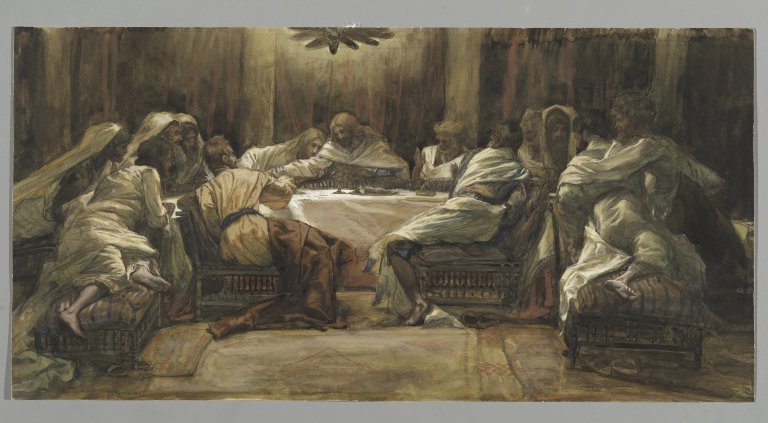
The Last Supper: Judas Dipping his Hand in the Dish
James Tissot, ca.1886-1894 (Brooklyn Museum Collection)
My dear friends,
On this solemn day, we are invited into the tender and piercing intimacy of the heart of Christ, which from the perspective of the Bodhisattva path we may recognize as the awakened mind of boundless compassion. Here, love does not withdraw in the face of betrayal. It remains present, knowing fully the suffering that ignorance brings. This passage reveals the meeting of wisdom and sorrow, of clear seeing and unshakable love.
"Very truly, I tell you, one of you will betray me."
- John 13:21
The disturbance in the spirit of Jesus is not confusion, it is compassion encountering the weight of karmic consequence. The awakened one perceives the unfolding of causes and conditions, and feels deeply the suffering that will arise. This is the sorrow of the Bodhisattva, who sees clearly and yet does not turn away.
uncertain of whom he was speaking.
- John 13:22
This uncertainty reflects the ordinary mind, which is obscured by ignorance. Each one looks outward, wondering who among them could fall. Yet the deeper practice invites us inward, to recognize that the seeds of betrayal, fear, and self-clinging exist in every heart until they are transformed by wisdom and compassion.
Simon Peter therefore motioned to him to ask Jesus of whom he was speaking.
So while reclining next to Jesus, he asked him, "Lord, who is it?"
- John 13:23-25
The disciple resting close to the heart of Jesus symbolizes the contemplative mind abiding in intimacy with awakened awareness. From such closeness arises the courage to inquire deeply. On the path, we cultivate this nearness, resting our awareness in love itself, so that truth may be revealed without distortion.
And they were very distressed...Bach, St Matthew Passion, Mvts. 9d-10
| Und sie wurden sehr betrübt und huben an, ein
jeglicher unter ihnen, und sagten zu ihm: Herr, bin ich's?
And they were very distressed and began each one among them to say
to him:
Lord, is it I? |
|
| Ich bin's, ich sollte büßen, An Händen und an Füßen Gebunden in der Höll. Die Geißeln und die Banden Und was du ausgestanden, Das hat verdienet meine Seel. |
I am the one who should atone,
Bound hand and foot in Hell. The lashes and the fetters And what you endured - That is what my soul has deserved. |
This question, "Is it I?", is the gateway to transformation. It is the practice of honest self-examination, akin to purification in the Lam Rim tradition, where we take responsibility for the suffering we perpetuate. Rather than casting blame outward, the Bodhisattva turns inward with humility, recognizing that liberation begins with seeing clearly one's own mind.
So when he had dipped the piece of bread, he gave it to Judas son of Simon Iscariot.
After he received the piece of bread, Satan entered into him.
Jesus said to him, "Do quickly what you are going to do."
- John 13:26-27
Even here, the gesture of Jesus is one of offering. The bread is given without withholding, symbolizing that compassion extends even to the one who will cause harm. From the perspective of emptiness, there is no fixed enemy. There are only beings caught in delusion. The Bodhisattva responds with unwavering compassion, while allowing karma to unfold.
Some thought that, because Judas had the common purse,
Jesus was telling him, "Buy what we need for the festival,"
or that he should give something to the poor.
- John 13:28-29
The others interpret events through ordinary assumptions, unable to perceive the deeper unfolding. In our own lives, much remains hidden from conceptual understanding. Therefore we train in trust, in presence, and in compassionate action, even when the full meaning is unclear.
And it was night.
When he had gone out, Jesus said,
"Now the Son of Man has been glorified, and God has been glorified in him.
If God has been glorified in him, God will also glorify him in himself
and will glorify him at once."
- John 13:30-32
Night falls as ignorance ripens into action, yet at that very moment, Jesus speaks of glory. This is the profound vision of the awakened mind, which sees that even suffering can become the path of liberation. When self-clinging is relinquished completely, what appears as loss reveals itself as the radiance of divine love, empty, luminous, and free.
Therefore, dear friends, let us walk this path with courage. Let us ask sincerely, "Is it I?", and allow that question to open the heart. Let us remain close to the heart of Christ, cultivating bodhicitta in every thought and action. In this way, even the darkness we encounter becomes the ground for awakening, and the world itself is transformed through compassion and wisdom.