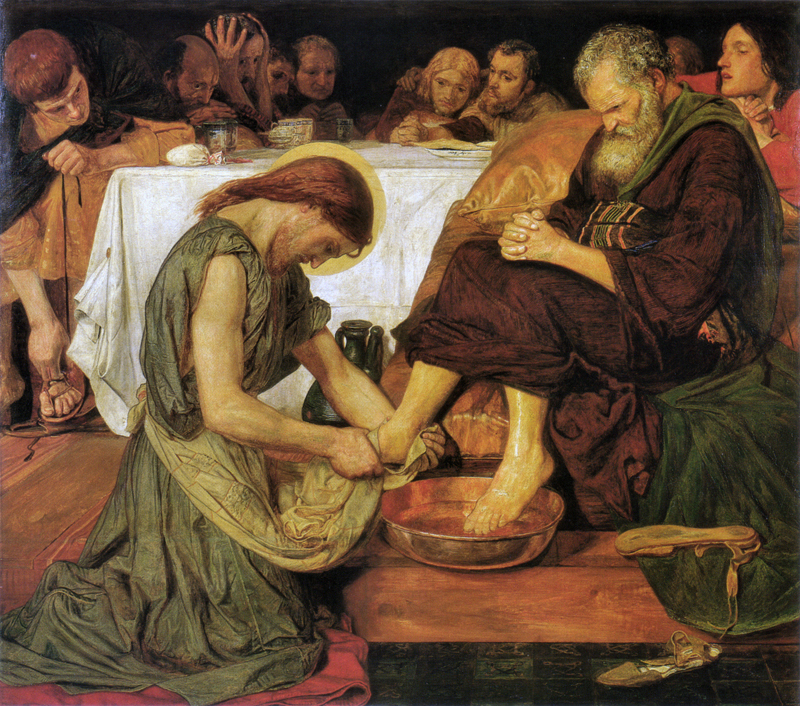
Jesus Washing Peter's Feet
Ford Madox Brown, 1854
My dear friends,
On this holy evening of Maundy Thursday, we are invited to contemplate the union of boundless compassion and skillful means. In the gesture of Jesus Christ , we behold the living expression of bodhicitta, the awakened heart that seeks nothing for itself and pours itself out for the liberation of all beings. This is the mind of Christ, the Holy Spirit as living compassion, which the Bodhisattva cultivates through discipline, meditation, and wisdom. Let us enter this mystery not as distant observers, but as participants in the path.
Jesus knew that his hour had come
to depart from this world and go to the Father.
Having loved his own who were in the world,
he loved them to the end.
- John 13:1
To love “to the end” is the perfection of the Bodhisattva vow. It is love that does not retreat when suffering appears, nor diminish when death approaches. This is the courage born from realizing emptiness, that there is no separate self to defend, and therefore nothing to withhold. Such love flows naturally when the illusion of separateness dissolves, and all beings are seen as one’s own life.
and that he had come from God and was going to God,
got up from supper, took off his outer robe, and tied a towel around himself.
Then he poured water into a basin and began to wash the disciples' feet
and to wipe them with the towel that was tied around him.
- John 13:12b-5
Here we see the union of wisdom and humility. Knowing his divine origin, he lowers himself completely. This is the Bodhisattva’s way: the higher the realization, the deeper the bow. Washing feet becomes a sacred act, a practice of purifying the obscurations of others through compassion. In lojong practice, we train to take the lowest place, transforming pride into service, and service into awakening.
Jesus answered, "You do not know now what I am doing, but later you will understand."
- John 13:6-7
Spiritual understanding often unfolds after the fact. At first, the ego resists what appears beneath dignity or contrary to expectation. Yet the path reveals itself through practice. In time, the disciple recognizes that what seemed like humiliation is actually liberation, a loosening of self-grasping.
Jesus answered, "Unless I wash you, you have no share with me."
Simon Peter said to him, "Lord, not my feet only but also my hands and my head!"
- John 13:8-9
To receive compassion is itself a practice. Many wish to give, yet resist being served. The Bodhisattva path requires both. Allowing oneself to be washed is the surrender of pride, the recognition of interdependence. When Peter opens fully, we see the longing for total purification, the aspiration to be wholly transformed.
And you are clean, though not all of you."
For he knew who was to betray him; for this reason he said, "Not all of you are clean."
- John 13:10-11
Even among practitioners, obscurations remain. The path does not deny this, it illuminates it. The feet, touching the ground of worldly engagement, symbolize the subtle defilements that accumulate through contact with ignorance. Daily purification, through mindfulness and compassion, keeps the path clear.
he said to them, "Do you know what I have done to you?
You call me Teacher and Lord, and you are right, for that is what I am.
So if I, your Lord and Teacher, have washed your feet, you also ought to wash one another's feet.
For I have set you an example, that you also should do as I have done to you."
- John 13:12-15
The teaching is clear: realization must become action. Compassion that remains inward is incomplete. The Bodhisattva trains to recognize every encounter as an opportunity to serve, to relieve suffering in whatever form it appears. This is the practice of exchanging self and other, seeing others as equally precious as oneself.
nor are messengers greater than the one who sent them.
If you know these things, you are blessed if you do them."
- John 13:16-17
Blessing arises through embodiment. Knowledge alone does not liberate. When wisdom descends into conduct, it becomes virtue, and virtue matures into awakening. This is the integration of the three higher trainings: ethical discipline, meditative stability, and penetrating insight.
You will look for me, and as I said to the Jews so now I say to you,
'Where I am going, you cannot come.'"
- John 13:33
The teacher points beyond himself. The path must be walked inwardly. Though the form departs, the awakened mind remains accessible. The Bodhisattva understands that the true teacher is the realization of emptiness united with compassion, arising within one’s own mindstream.
Just as I have loved you, you also should love one another.
By this everyone will know that you are my disciples, if you have love for one another."
- John 13:34-35
This “new commandment” is the heart of the Bodhisattva vow. To love as the awakened one loves is to transcend self-centeredness completely. Such love is impartial, fearless, and wise. It recognizes no boundary between self and other, and thus becomes the path itself, the fruit, and the offering to all beings.
Therefore, my dear friends, on this sacred night, contemplate deeply this act of washing feet. Let it become your meditation, your discipline, and your vow. Wherever there is suffering, kneel. Wherever there is pride, bow. Wherever there is division, love. In this way, you walk the path of the Bodhisattva, and the mind of Christ will awaken within you.