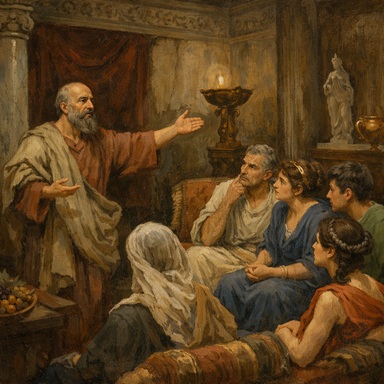
Paul Preaching in Corinth
Created by ChatGPT 5.2, 2026-02-04
My dear friends,
In 1 Corinthians 2:1-16, the Apostle Paul speaks as one who has discovered that the deepest truth cannot be carried by display, cleverness, or spiritual ambition. From the perspective of the Bodhisattva path, this chapter reveals the maturation of the mind from reliance on conceptual mastery into reliance on the Spirit. The "Spirit of God", the "mind of Christ", and bodhicitta can be understood as one reality: the awakened mind of self-giving love inseparable from wisdom.
came not with excellency of speech or of wisdom,
declaring unto you the testimony of God.
For I determined not to know any thing among you,
save Jesus Christ, and him crucified.
- 1 Corinthians 2:1-2
Paul’s determination to know only Christ crucified mirrors the Bodhisattva’s vow to hold compassion as the sole reference point of life. The crucified Christ signifies the complete relinquishment of self-clinging. This is the abandonment of grasping at reputation, control, and certainty, so that the mind may rest in love that seeks the welfare of others without calculation.
- 1 Corinthians 2:3
When the heart is stripped of pretense, it becomes permeable to the Spirit. Trembling here is the body’s acknowledgment that something greater than ego is at work.
but in demonstration of the Spirit and of power:
That your faith should not stand in the wisdom of men,
but in the power of God.
- 1 Corinthians 2:4-5
The power Paul names is the transforming energy of awakened mind. Bodhicitta carries its own authority because it arises from direct realization, supported by ethical discipline and meditative stability. Faith grounded in this power is experiential, stable amid change, and not dependent on argument or charisma.
yet not the wisdom of this world,
nor of the princes of this world, that come to nought.
- 1 Corinthians 2:6
Paul acknowledges stages of understanding. There is a wisdom accessible only as the mind matures through practice. Worldly wisdom seeks advantage and permanence, while awakened wisdom sees impermanence clearly and therefore acts without fear, attachment, or despair.
which God ordained before the world unto our glory:
Which none of the princes of this world knew:
for had they known it, they would not have crucified the Lord of glory.
- 1 Corinthians 2:7-8
This hidden wisdom is compassion united with emptiness. Because it does not operate through domination or self-protection, it remains unintelligible to minds trained in power. Ignorance responds to such freedom with violence. Yet the very suffering inflicted becomes a teaching, revealing the tragic blindness of grasping mind.
neither have entered into the heart of man,
the things which God hath prepared for them that love him.
But God hath revealed them unto us by his Spirit:
for the Spirit searcheth all things, yea, the deep things of God.
For what man knoweth the things of a man, save the spirit of man which is in him?
even so the things of God knoweth no man, but the Spirit of God.
- 1 Corinthians 2:9-11
Here Paul points beyond conceptual knowing. What is prepared for those who love is realized only through direct awareness. In Buddhist language, this is nonconceptual wisdom realizing emptiness. The Spirit that searches the depths of God is bodhicitta recognizing its own nature as boundless compassion and clarity.
but the spirit which is of God;
that we might know the things that are freely given to us of God.
Which things also we speak, not in the words which man's wisdom teacheth,
but which the Holy Ghost teacheth;
comparing spiritual things with spiritual.
- 1 Corinthians 2:12-13
The spirit of the world is the habit of comparison, acquisition, and fear. The Spirit from God is the awakening mind that knows generosity as its own expression. When speech arises from this source, it naturally resonates with those whose hearts are already turning toward awakening.
for they are foolishness unto him:
neither can he know them, because they are spiritually discerned.
But he that is spiritual judgeth all things,
yet he himself is judged of no man.
- 1 Corinthians 2:14-15
The natural mind seeks certainty through control and appearance. Awakened discernment arises from inner transformation, not external approval. The one established in bodhicitta can meet praise or blame without distortion, because understanding is rooted in lived realization rather than social validation.
But we have the mind of Christ.
- 1 Corinthians 2:16
To have the mind of Christ is to participate in the awakened mind itself: bodhicitta, the Spirit of God alive within human consciousness. It knows emptiness without falling into nihilism, and it loves without clinging. To abide here is both profound humility and limitless compassion.
Paul’s teaching aligns seamlessly with the Bodhisattva path. The Spirit, the mind of Christ, and bodhicitta name one living reality, the awakening of love and wisdom within the human heart, offered freely for the healing of the world.