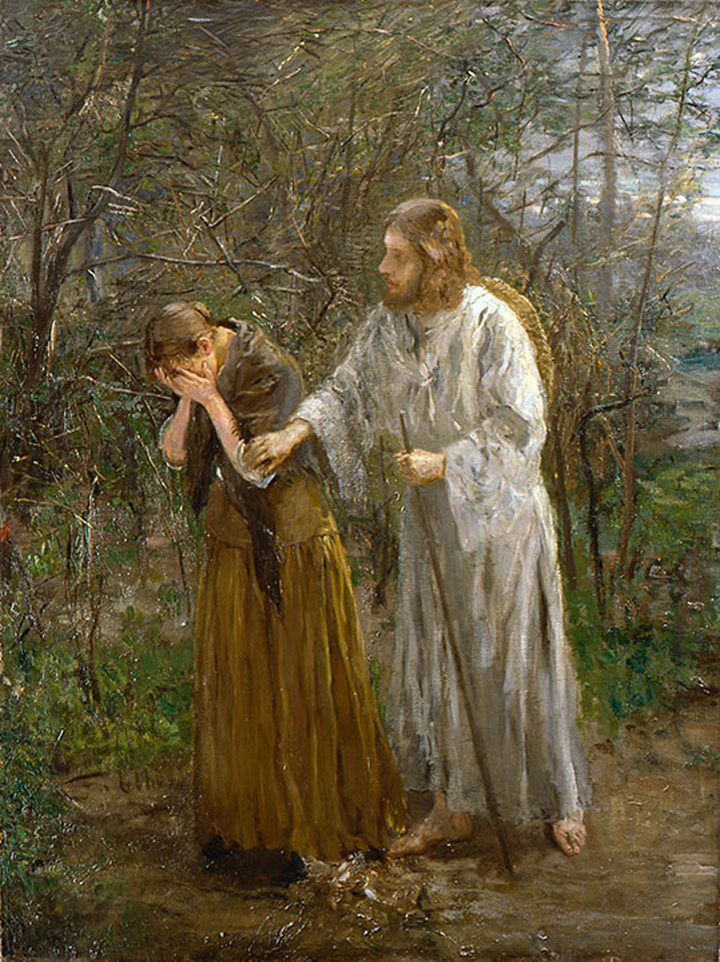
Woman, Why Weepest Thou?
Fritz von Uhde, 1893
My dear friends,
From the perspective of the Bodhisattva path, the Resurrection is not only an event in time, but a revelation of the indestructible nature of awakened mind, the living presence of compassion and wisdom that cannot be confined by death. Mary Magdalene, whose devotion is unwavering, becomes the first to witness this mystery, showing us that the heart of love, refined through suffering, becomes the vessel of direct realization.
while it was still dark,
Mary Magdalene came to the tomb
and saw that the stone had been removed from the tomb.
So she ran and went to Simon Peter
and the other disciple, the one whom Jesus loved,
and said to them,
"They have taken the Lord out of the tomb,
and we do not know where they have laid him."
- John 20:1-2
Mary comes while it is still dark. This darkness is the ignorance that veils all beings, yet her movement toward the tomb is already the stirring of bodhicitta, the courageous intention to seek truth for the sake of love. The stone being removed reveals that what we take to be final, fixed, and sealed is in fact empty of inherent solidity. Her first response is confusion and grief, reminding us that the initial encounter with emptiness can feel like loss when wisdom has not yet matured into direct seeing.
The two were running together, but the other disciple outran Peter and reached the tomb first.
He bent down to look in and saw the linen wrappings lying there, but he did not go in.
- John 20:3-5
The disciples run toward the tomb, driven by urgency, yet they hesitate at its threshold. This reflects the practitioner who approaches realization through effort and inquiry, yet pauses before entering fully into the direct experience of emptiness. Seeing the wrappings without entering suggests conceptual understanding without full realization, a glimpse that invites deeper courage.
He saw the linen wrappings lying there, and the cloth that had been on Jesus's head,
not lying with the linen wrappings but rolled up in a place by itself.
Then the other disciple, who reached the tomb first, also went in, and he saw and believed,
for as yet they did not understand the scripture, that he must rise from the dead.
- John 20:6-9
Peter enters, and the beloved disciple follows, and there is a moment of belief without full understanding. On the Bodhisattva path, this is the arising of faith that precedes wisdom. One sees signs of the deathless, yet the scriptures remain veiled. Faith here is not blind acceptance, it is the opening of the heart that allows insight to ripen over time through practice, meditation, and ethical living.
As she wept, she bent over to look into the tomb, and she saw two angels in white
sitting where the body of Jesus had been lying, one at the head and the other at the feet.
They said to her, "Woman, why are you weeping?"
She said to them, "They have taken away my Lord, and I do not know where they have laid him."
- John 20:10-13
Mary remains when others return home. This is of great significance. The Bodhisattva does not turn away from suffering or uncertainty, but abides with it. Her weeping is not a failure, it is compassion in its raw form. Because she stays present to her grief, the deeper vision opens. The angels appear where the body had been, pointing to the transformation of ordinary perception into sacred awareness when one does not flee from sorrow.
but she did not know that it was Jesus.
- John 20:14
Even when she beholds Jesus, she does not recognize him. This shows how the awakened nature can be present, yet unrecognized due to habitual perception. We often look directly at truth and fail to see it, because we expect it to conform to our concepts. The risen presence appears ordinary, like a gardener, reminding us that awakening is not elsewhere but within the field of everyday experience.
Supposing him to be the gardener, she said to him,
"Sir, if you have carried him away, tell me where you have laid him, and I will take him away."
Jesus said to her, "Mary!"
She turned and said to him in Hebrew, "Rabbouni!" (which means Teacher).
- John 20:15-16
When he calls her by name, recognition dawns instantly. This is the moment of direct realization, beyond analysis. In the language of the path, this is the meeting of wisdom and devotion, where the mind of Christ, the awakened mind of love, recognizes itself. Her response, “Teacher,” expresses both intimacy and reverence, the unobscured vision of truth.
But go to my brothers and say to them,
'I am ascending to my Father and your Father, to my God and your God.'"
- John 20:17
“Do not cling to me,” he says. This is a profound instruction. Even sacred experience must not be grasped. The Bodhisattva learns to release attachment even to the most sublime realization, allowing it to deepen into boundless compassion. The movement now turns outward; she is sent to others. Realization flowers as service.
and she told them that he had said these things to her.
- John 20:18
Mary Magdalene becomes the first to proclaim the Resurrection. This is no small detail. It reveals that the one who abides in love, who remains present to suffering, who sees directly, becomes the bearer of awakening for others. In the Bodhisattva path, realization is never for oneself alone. Her testimony, “I have seen the Lord,” is the expression of awakened awareness shared for the benefit of all beings.
Thus, dear friends, the Resurrection is the unveiling of the awakened mind that was never truly absent. It calls us to move through darkness with courage, to remain with suffering without turning away, and to recognize the living presence of wisdom and compassion in our midst. Like Mary Magdalene, may we hear our name spoken in the depths of awareness, awaken to the truth beyond death, and go forth as instruments of boundless love for the liberation of all beings.
I know that my Redeemer liveth