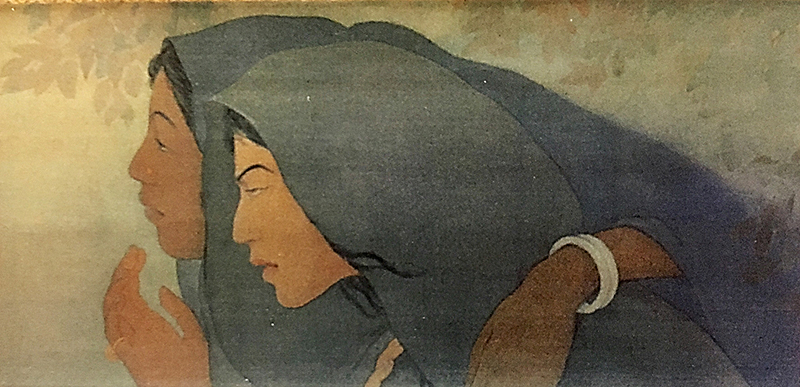
As it Began to Dawn
Frank Wesley, 1923-2002
My dear friends,
On this holy night of the Easter Vigil, we keep watch at the threshold between darkness and dawn. The Church proclaims resurrection, and the Bodhisattva hears in this proclamation the arising of bodhicitta, the awakened heart that embraces all beings. Baptism into Christ is not merely a rite of belonging, it is a profound entry into the path of transformation, where self-clinging is relinquished and a new way of being is born. This is the path where death itself becomes the gate of compassion and wisdom.
Therefore we are buried with him by baptism into death:
that like as Christ was raised up from the dead by the glory of the Father,
even so we also should walk in newness of life.
- Romans 6:3-4
To be baptized into his death is to consent to the relinquishing of the false self, the constructed identity that grasps and fears. In the language of the Bodhisattva path, this is the beginning of seeing emptiness, the lack of inherent, separate existence. As Christ enters death without resistance, so the practitioner allows the old patterns of ignorance to dissolve. The rising into new life is the emergence of awakened conduct, where one walks in compassion, guided by the Spirit, which is the living current of bodhicitta.
we shall be also in the likeness of his resurrection:
Knowing this, that our old man is crucified with him,
that the body of sin might be destroyed, that henceforth we should not serve sin.
For he that is dead is freed from sin.
- Romans 6:5-7
To be planted together with Christ is to enter deeply into the soil of practice, where humility and perseverance take root. The crucifixion of the old self is the undoing of habitual grasping, the patterns that bind us to suffering. When these are seen clearly and released, their power fades. Freedom from sin here may be understood as freedom from ignorance and compulsive reactivity. The Bodhisattva does not flee the world, yet is no longer enslaved by it, for wisdom has cut through the illusion of separateness.
Knowing that Christ being raised from the dead dieth no more; death hath no more dominion over him.
- Romans 6:8-9
“Death hath no more dominion over him” may be received with quiet reverence rather than bold claim. It points us toward a freedom that unfolds as we yield to “the law of the Spirit of life in Christ Jesus,”[*] a gentle liberation from the habits that bind the heart. As this life grows within us, fear begins to loosen, for “perfect love casts out fear.”[*] We may not yet abide fully in such love, yet each moment of sincere compassion, each turning away from grasping, participates in this freedom. In this way, step by step, we learn to trust a life that is less governed by fear and more shaped by love.
Likewise reckon ye also yourselves to be dead indeed unto sin,
but alive unto God through Jesus Christ our Lord.
- Romans 6:10-11
To reckon oneself dead to sin is an act of deep contemplation and commitment. It is to recognize that the habits of ignorance have no ultimate ground. To be alive unto God is to live in attunement with ultimate reality, which the Bodhisattva knows as emptiness inseparable from compassion. This life is expressed in every thought, word, and deed that benefits others. The resurrection life is therefore not distant or abstract, it is present wherever selfless love manifests.
Beloved companions on the path, this night invites us to renew our vow. Let us die to the narrowness of self and awaken to the vast heart of Christ, which embraces all beings without exception. In this way, the light of Easter dawns within us, and we become bearers of that light in a world longing for liberation. Walk gently, persevere steadily, and let your life become a blessing for all.