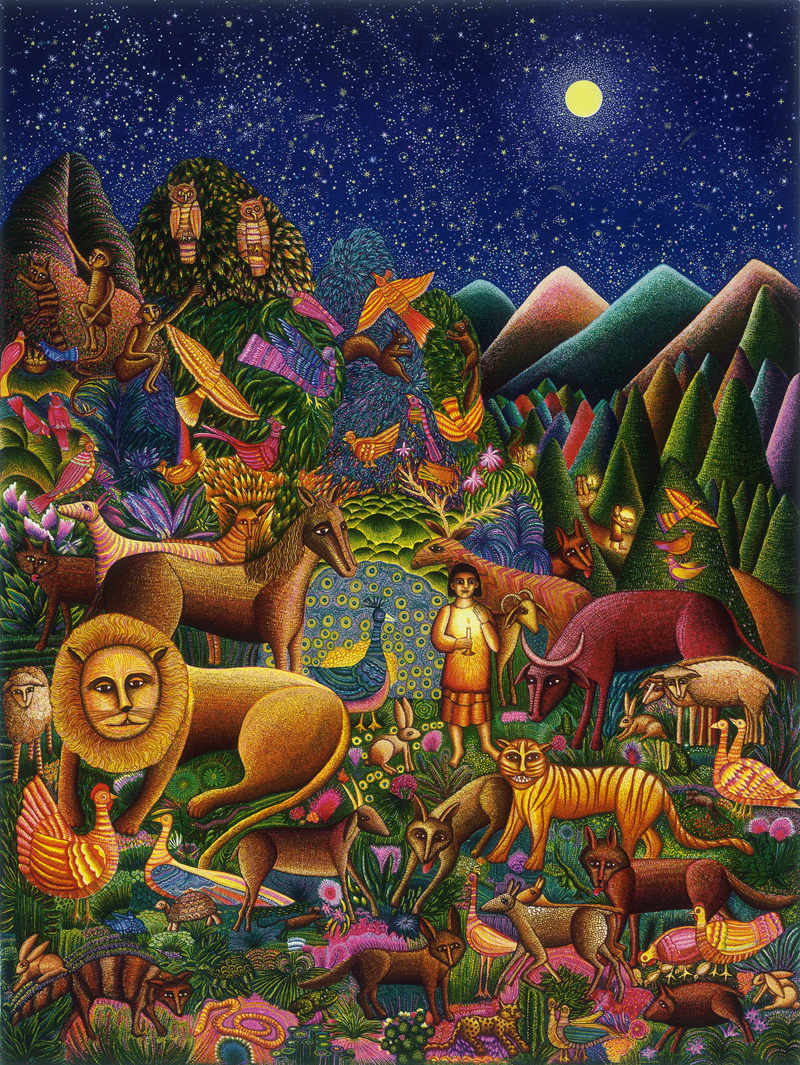
Peaceable Kingdom
John August Swanson, 1994
My dear friends,
On this second Sunday of Advent, the prophet Isaiah offers us not a prediction to be decoded, but a vision to be inhabited. Isaiah speaks to a people who have known devastation, the royal tree cut down to a stump. This image invites us to contemplate hope that does not depend on outward power, but on the quiet, persistent life of compassion arising from apparent loss. Advent trains our eyes to recognize this tender shoot within ourselves and within the world.
and a branch shall grow out of his roots.
- Isaiah 11:1
The Bodhisattva path begins exactly here, where all conceit of permanence has been stripped away. The stump of Jesse is the exhausted ego, the collapsed empire of self reliance. From this emptiness, life reappears. In Buddhist terms, this is the fertile ground of śūnyatā, where bodhicitta can arise. In Christian language, it is grace, not earned but given. The stump is dry and powerless, but the root lies waiting to rise again with the rain.
the spirit of counsel and might, the spirit of knowledge and the fear of the LORD.
His delight shall be in the fear of the LORD.
- Isaiah 11:2-3a
This sevenfold spirit mirrors the balanced training of the path. Wisdom and understanding correspond to right view, counsel and might to compassionate action, knowledge and reverent awe to humility before reality. The fear of the LORD is not terror, but intimacy with truth. It is what we call mindfulness suffused with love. The delight of the awakened one is to remain attuned to what is real, rather than to the seductions of grasping and aversion.
but with righteousness he shall judge for the poor
and decide with equity for the oppressed of the earth;...
- Isaiah 11:3b-4a
Here the prophet describes the non-dual vision of the Bodhisattva. Ordinary judgment relies on appearances and inherited narratives. Awakened judgment arises from direct seeing of suffering. To judge for the poor is not a moral preference, but a clarity born of compassion. When self centered perception loosens, equity becomes possible, because the boundary between self and other is seen through.
and with the breath of his lips he shall kill the wicked.
- Isaiah 11:4b
This is not a call to violence, but a revelation of the power of truth. The rod of the mouth is skillful speech, which dismantles delusion. The wicked that are slain are greed, hatred, and ignorance, the poisons that rule the untrained mind. When speech arises from wisdom and compassion, falsehood cannot survive it. This is the gentle but relentless force of the Dharma and of the Gospel.
and faithfulness the belt around his loins.
- Isaiah 11:5
The belt binds the body for action. Righteousness and faithfulness are not abstract virtues, but embodied commitments. On the Bodhisattva path, ethical discipline stabilizes the energy of practice. Fidelity to love and truth keeps compassion from becoming sentimental and wisdom from becoming cold. This is integrity lived in the muscles and breath of daily life.
the calf and the lion will feed together, and a little child shall lead them.
- Isaiah 11:6
This beloved image is the fruit of inner transformation. When the divided mind is healed, predator and prey within us no longer wage war. The child who leads them is beginner’s mind, humble, undefended, and free from domination. Such innocence is not naïveté, but the maturity of one who no longer needs to prove or protect a self.
and the lion shall eat straw like the ox.
- Isaiah 11:7
Here Isaiah stretches our imagination toward a world reordered by compassion. On the Bodhisattva path, this begins with renunciation of harm. When craving is pacified, the lion eats straw. Energy once used to dominate becomes nourishment for shared life. Such peace may appear impossible, yet it begins wherever one heart relinquishes violence.
and the weaned child shall put its hand on the adder's den.
- Isaiah 11:8
This verse speaks of fearlessness born of trust. When wisdom sees emptiness and love knows no enemy, even the places of danger lose their power. The child does not dominate the serpent, nor is it consumed by it. This is the confidence of one who abides in God, or in the awakened mind, without clinging.
for the earth will be full of the knowledge of the LORD as the waters cover the sea.
- Isaiah 11:9
The holy mountain is not elsewhere. It is the field of experience transformed by awareness. When knowledge of the LORD, which is intimate knowing, not information, permeates life like water saturates the sea, harm becomes unthinkable. This is the fulfillment of bodhicitta, the mind that cannot bear the suffering of another.
the nations shall inquire of him, and his dwelling shall be glorious.
- Isaiah 11:10
The awakened life becomes a sign not by force, but by attraction. When compassion and wisdom are embodied, others naturally inquire. The dwelling that is glorious is the human heart made spacious by love. Advent invites us not merely to await this figure, but to consent to this work within us.
My friends, Isaiah’s vision is not postponed to the end of time. It is entrusted to us now. Each moment of patience, each refusal to dehumanize, each act of courageous tenderness allows the shoot to grow. May this Advent season deepen our willingness to become a peaceable kingdom, for the sake of all beings.