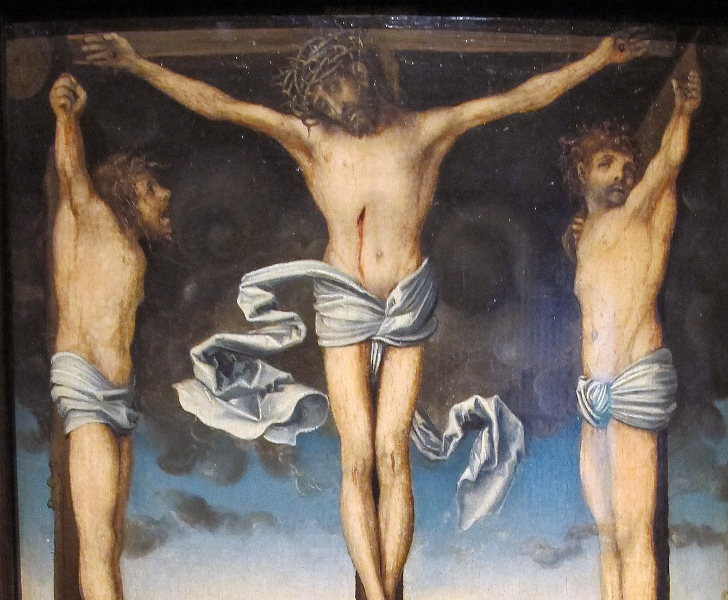
Christ on the Cross Between the Two Thieves
Lucas Cranach, 1518
My dear friends,
On this centenary observance of the Feast of Christ the King, the Revised Common Lectionary places before us the crucifixion scene from Luke 23:33–43. At first it seems a paradoxical choice for a day devoted to Christ’s sovereignty, yet in the combined light of the Christian and Bodhisattva paths, this passage reveals the deepest meaning of divine kingship—a kingship not of dominance but of liberating compassion, not enthroned above suffering but present within it for the sake of all beings.
that is called The Skull,
they crucified Jesus there with the criminals,
one on his right and one on his left.
Then Jesus said, “Father, forgive them;
for they do not know what they are doing.”
And they cast lots to divide his clothing.
And the people stood by, watching;
but the leaders scoffed at him, saying,
“He saved others;
let him save himself
if he is the Messiah of God, his chosen one!”
The soldiers also mocked him,
coming up and offering him sour wine,
and saying,
“If you are the King of the Jews,
save yourself!”
There was also an inscription over him,
“This is the King of the Jews.”
One of the criminals who were hanged there
kept deriding him and saying,
“Are you not the Messiah?
Save yourself and us!”
But the other rebuked him, saying,
“Do you not fear God, since you are under
the same sentence of condemnation?
And we indeed have been condemned justly,
for we are getting
what we deserve for our deeds,
but this man has done nothing wrong.”
Then he said, “Jesus, remember me
when you come into your kingdom.”
He replied, “Truly I tell you,
today you will be with me in Paradise.”
Just as the Bodhisattva refuses to abandon sentient beings in their suffering, remaining with them until all are liberated, Jesus does not descend from the cross even when taunted to prove his authority. His kingship is revealed not in escape but in presence—the self-emptying love that chooses to dwell exactly where human pain is deepest, so that no being need face it alone. Christian tradition calls this kenosis, the pouring out of divine life; Mahayana tradition calls it mahākaruṇā, great compassion. In the cross, both languages converge.
The mockery surrounding Jesus mirrors the delusions that bind beings to the wheel of samsāra, deluded beliefs that true worth must be demonstrated through power, control, or victory. “Save yourself,” the voices cry, but Christ unmasks the tyranny of false kingship. His silence before insult becomes the royal judgment that exposes the emptiness of domination and the hollowness of cruelty.
The two criminals embody divergent responses to suffering. One repeats the world’s cynicism: “Are you not the Messiah? Save yourself and us!” The other speaks with the honesty that both the Gospel and the Dharma cherish: acknowledgment of one’s karma, recognition of goodness in another, and the tender aspiration, “Remember me.” In this moment he touches the edge of bodhicitta—the opening of a heart that longs for healing and truth. Jesus’ response, “Today you will be with me in Paradise,” reveals the immediacy of grace and the possibility of awakening. Paradise is not deferred reward but the intimate nearness of the One who embodies perfect compassion.
Thus, on this Feast of Christ the King, kingship is redefined. It is not the sovereignty of force, but the sovereignty of compassion; not an exaltation above suffering, but a willingness to enter it for the sake of all. In Christian language, Christ reigns from the cross. In Bodhisattva language, he abides in the heart of samsāra until all beings are freed. This is the nondual truth in which both paths meet: that the highest love is found in the lowest place, and that the transformation of suffering into compassion is the crowning work of one who truly rules by love alone.