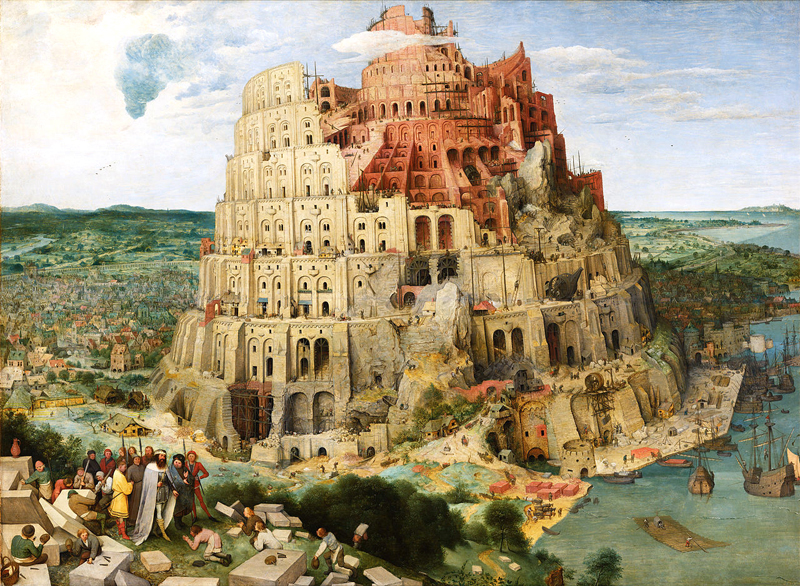
Tower of Babel
Pieter Bruegel, 1563
My dear friends,
Today, we commemorate Pentecost—a day that invites us to reflect deeply on the transformative power of communication grounded in compassion and wisdom. The story of Pentecost is not merely about the phenomenon of speaking in many tongues, but about the Holy Spirit empowering the disciples to reach each listener in their own native language. This is an example of what in the Buddhist tradition is known as "skillful means" (upaya): the compassionate ability to tailor teachings to the needs and understanding of the hearers. In this light, the Holy Spirit’s action is the awakening of Bodhicitta, the mind of love, compassion, and insight, which brings unity not through uniformity, but through mutual understanding. As we explore the scriptures, let us attune ourselves to this capacity to interpret, to listen, and to speak in ways that heal division and open the heart.
And as they migrated from the east, they came upon a plain in the land of Shinar and settled there.
And they said to one another, "Come, let us make bricks, and burn them thoroughly."
And they had brick for stone, and bitumen for mortar.
Then they said, "Come, let us build ourselves a city,
and a tower with its top in the heavens, and let us make a name for ourselves;
otherwise we shall be scattered abroad upon the face of the whole earth."
The LORD came down to see the city and the tower, which mortals had built.
And the LORD said, "Look, they are one people, and they have all one language;
and this is only the beginning of what they will do;
nothing that they propose to do will now be impossible for them.
Come, let us go down, and confuse their language there,
so that they will not understand one another's speech."
So the LORD scattered them abroad from there over the face of all the earth,
and they left off building the city.
Therefore it was called Babel(*), because there the LORD confused the language of all the earth;
and from there the LORD scattered them abroad over the face of all the earth.
- Genesis 11:1-9
The Babel narrative portrays a moment when human beings, speaking one language, sought to make a name for themselves through their own designs. Their unity, however, was not rooted in compassion or mutual understanding, but in self-exaltation. The resulting confusion of language symbolizes the breakdown of true communication when ego and pride are the driving forces. This is a cautionary tale that reminds us: without the awakened intention of bodhicitta, our efforts—even when unified—can lead to fragmentation. Authentic unity is not imposed from above, but arises from the humble recognition of others’ needs and perspectives. The scattering of Babel is undone at Pentecost, not by homogenizing language, but by empowering each person to hear the divine message in their own voice.
So they [the Levites] read from the book, from the law of God, with interpretation.
They gave the sense, so that the people understood the reading.
- Nehemiah 8:5,8
In Nehemiah, we witness a moment of sacred interpretation: the Levites not only read from the law, but also gave the sense of it, enabling the people to understand. This is a holy act of compassionate translation. They did not simply parrot scripture; they conveyed meaning in a way the people could receive. This is the heart of skillful means: the ability to bridge the gap between sacred truth and human understanding. It is a living expression of bodhicitta, the desire to liberate others through wisdom attuned to their unique condition. In this way, the Levites serve as exemplars of spiritual maturity, showing that the deepest knowledge bears fruit when it is lovingly made accessible.
do not worry beforehand about what you are to say;
but say whatever is given you at that time,
for it is not you who speak, but the Holy Spirit.
- Mark 13:11
When Christ tells his followers not to worry about what to say, for the Holy Spirit will speak through them, he affirms the deep trust in a wisdom that is responsive and present. This is not passive submission but a dynamic readiness, a heart grounded in bodhicitta, capable of responding with clarity and love to the needs of the moment. This is the essence of skillful means: not rehearsed formulas, but spontaneous compassion arising from deep inner stillness. In the Christian tradition, this is the mind of Christ; in the Buddhist tradition, it is the awakened mind that speaks in ways that benefit. Both point to the same reality: wisdom born of love.
And suddenly from heaven there came a sound like the rush of a violent wind,
and it filled the entire house where they were sitting.
Divided tongues, as of fire, appeared among them, and a tongue rested on each of them.
All of them were filled with the Holy Spirit and began to speak in other languages,
as the Spirit gave them ability.
Now there were devout Jews from every nation under heaven living in Jerusalem.
And at this sound the crowd gathered and was bewildered,
because each one heard them speaking in the native language of each.
Amazed and astonished, they asked,
"Are not all these who are speaking Galileans?
And how is it that we hear, each of us, in our own native language?"
- Acts 2:1-11
The Pentecost event reveals the Holy Spirit not simply as a giver of tongues, but as the one who opens channels of understanding. Each person hears in their own language—not because the apostles impose one message, but because the Spirit adapts the message to each heart. This is divine upaya, skillful means in its purest form. It is the Holy Spirit as interpreter, as the mind of Christ making itself known in the intimate language of every soul. Pentecost is not about theological uniformity but about compassionate pluralism, God speaking many tongues to gather scattered hearts. In our own lives, this calls us to speak and act in ways that consider the listener, honoring the sacred diversity of paths and perceptions.
These sacred texts reveal a profound teaching: divine communication is not about imposing understanding but about inspiring it through compassion and wisdom. From the fragmentation of Babel to the interpretive compassion of the Levites, from Christ’s promise of Spirit-guided speech to the miracle of Pentecost, we are shown that the gift of the Spirit is not merely to speak, but to be heard in the heart’s language. This is the gift of bodhicitta: the desire and the skill to benefit others in ways they can truly receive. As followers of the Way of Jesus the Christ and the Dharma of the Buddha, may we become interpreters of the divine, speaking not only in words but through actions of love, always seeking to understand before we are understood, and always aspiring for the awakening of all.