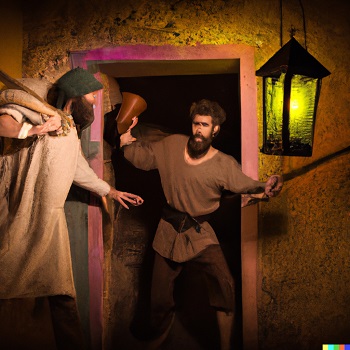
A Thief in the Night
Created by DALL·E 2, 2023-09-05
My dear friends,
In Luke 12:32-40, we encounter a call to live with clarity, compassion, and non-attachment.
for it is your Father's good pleasure
to give you the kingdom.
Sell your possessions and give alms.
Make purses for yourselves that do not wear out,
an unfailing treasure in heaven,
where no thief comes near and no moth destroys.
For where your treasure is,
there your heart will be also."
- Luke12:32-34
This teaching of Jesus is a call to the first paramita: dāna, or generosity. We are encouraged to let go of our attachments—not as ascetics who despise the world, but as awakened ones who see that clinging to possessions binds the heart. The "kingdom" offered is not a material realm, but the treasure of bodhicitta, the awakened heart. Just as moth and rust cannot consume wisdom and compassion, so too the fruits of skillful actions (kusala-kamma), dedicated to the well-being of others, are imperishable.
be like those who are waiting for their master to return from the wedding banquet,
so that they may open the door for him as soon as he comes and knocks.
- Luke12:35-36
The image of being dressed and ready, with lamps lit, calls to mind the Bodhisattva's ever-ready commitment to respond to the suffering of beings. The lamp is the light of prajñā, wisdom that sees the emptiness of all things, and yet does not withdraw from the world. To be ever vigilant is to abide in mindfulness and compassion, like a mother who, even in sleep, is ready to rise for her child. The master’s return symbolizes the arising of opportunities to practice compassion at any moment, even in the darkest night. We are called to remain present and open, to answer the knock of bodhicitta on the door of our lives.
truly I tell you, he will fasten his belt and have them sit down to eat,
and he will come and serve them.
If he comes during the middle of the night, or near dawn, and finds them so,
blessed are those slaves."
- Luke12:37-38
In this extraordinary reversal, we glimpse the heart of the Christ and the heart of the Bodhisattva: the master becomes the servant. This is the supreme humility of awakened love. When we remain alert in compassion and service, we become worthy vessels of divine grace—and this grace does not come to dominate, but to nourish. The feast prepared by the master is the joy of mutual recognition: the Buddha-nature in us welcomes the Buddha-nature in all. Even at the darkest hour, if we remain steadfast, we discover that the one we waited for has already arrived in the form of the suffering beings around us.
if the owner of the house had known at what hour the thief was coming,
he would not have let his house be broken into.
You also must be ready, for the Son of Man is coming at an unexpected hour."
- Luke12:39-40
This warning is not one of fear, but of urgency. Just as impermanence can come like a thief in the night, so too must we be prepared to meet each moment as sacred. The "Son of Man" may be seen as the awakened mind itself, arising suddenly in the midst of our forgetfulness. The Bodhisattva trains in constant readiness, not by fearfully guarding possessions, but by cultivating the six perfections, so that whenever suffering calls, one is not caught unprepared.
Let us then live not as sleepers in a dream of self, but as those awakened in the light of love and wisdom. In Christ's call and the Bodhisattva vow we find one voice: to give ourselves wholly to others, to serve with joy, and to treasure the treasureless kingdom of the present moment. May our lamps be ever lit.