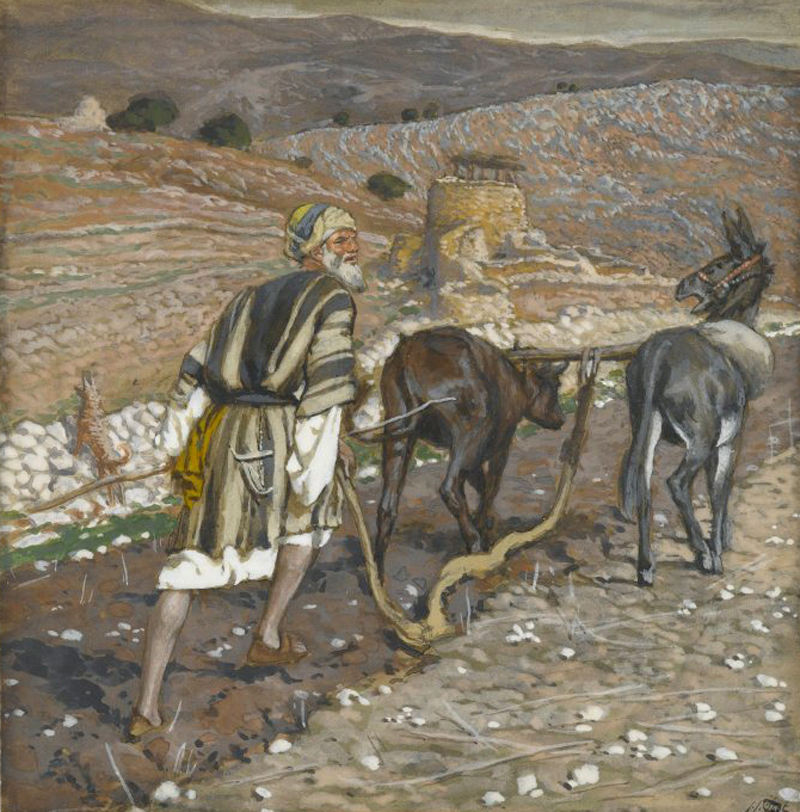
Looking Back - the man at the plow
James Tissot, 1890
My dear friends,
As we accompany the Christ on his journey toward Jerusalem, we enter the spiritual path of the Bodhisattva who has set their face not toward worldly comfort, but toward the liberation of all beings. Today's passage from Luke 9 reveals the cost and clarity of commitment needed on this path of awakening. Let us read it not only as history, but as inner instruction, pointing us toward the courage and detachment required to cultivate bodhicitta—the compassionate mind of Christ.
for him to be taken up,
he set his face to go to Jerusalem.
- Luke 9:51
In this solemn phrase, "he set his face," we recognize the deliberate resolve of the Bodhisattva. To go to Jerusalem is to walk directly into suffering, rejection, and death—not for oneself alone, but for the sake of the world. This is not grim fatalism, but the joyful embrace of suffering for the benefit of others, rooted in the wisdom of impermanence and the compassion that transcends fear.
On their way
they entered a village of the Samaritans
to prepare for his arrival,
but they did not receive him
because his face was set toward Jerusalem.
- Luke 9:52-53
Here we encounter sectarian resistance—the Samaritans rejecting the one who walks to a different sacred center. The Bodhisattva must walk through misunderstanding without resentment. To hold bodhicitta is to walk among all beings as kin, regardless of their affiliations. The awakened heart is not confined by cultural loyalties, but radiates love universally, even when unreciprocated.
"Lord, do you want us to command fire to come down from heaven and consume them?"
- Luke 9:54
The disciples’ suggestion recalls divine wrath upon inhospitable cities, but the Bodhisattva's path is not one of retribution. Like the Buddha who forbade retaliation against oppressors, the Christ here rejects coercion by force. Those who seek to follow him must learn that the kingdom of God is not established by fire, but by the fierce gentleness of love and forgiveness.
- Luke 9:55
This rebuke is a sign of the new dispensation—the age of compassion and wisdom. Just as the Mahayana teachings revealed a path beyond the solitary enlightenment of the arhat, so too does Christ call his followers beyond the old laws of judgment, into the radical mercy of the Bodhisattva, who renounces even the satisfaction of being right, for the sake of love.
As they were going along the road, someone said to him, "I will follow you wherever you go."
And Jesus said to him, "Foxes have holes, and birds of the air have nests,
but the Son of Man has nowhere to lay his head."
- Luke 9:56-58
This is the great renunciation. The Bodhisattva walks the earth as a pilgrim, not seeking material comfort, but rooted in the vow to liberate others. To say “I will follow you” is to relinquish all claims, to abide in the homelessness that is freedom, to find rest not in possessions but in compassion’s boundless field.
But he said, "Lord, first let me go and bury my father."
And Jesus said to him, "Let the dead bury their own dead,
but as for you, go and proclaim the kingdom of God."
- Luke 9:59-60
This hard saying strikes the chord of urgency. The dead here are not those who breathe no more, but those trapped in samsaric inertia. The Bodhisattva does not disdain the grieving, but sees that there is no time to waste. To proclaim the kingdom is to invite the awakening of all beings. The call to follow is always now.
And Jesus said to him,
"No one who puts a hand to the plow and looks back is fit for the kingdom of God."
- Luke 9:61-62
The furrow of the Bodhisattva's path cannot be straight if one is constantly looking back. Just as a ploughman must attend forward with full attention, so too must we fix our hearts on the kingdom—not a place, but the awakened life. Looking back with longing weakens resolve. The kingdom arises where there is unwavering bodhicitta.
May we, like Christ, set our face toward the Jerusalem of our innermost vow—the liberation of all beings. Let us be joyful in homelessness, patient in rejection, free from vengeance, and firm in resolve. The path is steep and narrow, but it is the path of love, and in walking it, we walk with Christ and with all awakened beings. Amen.