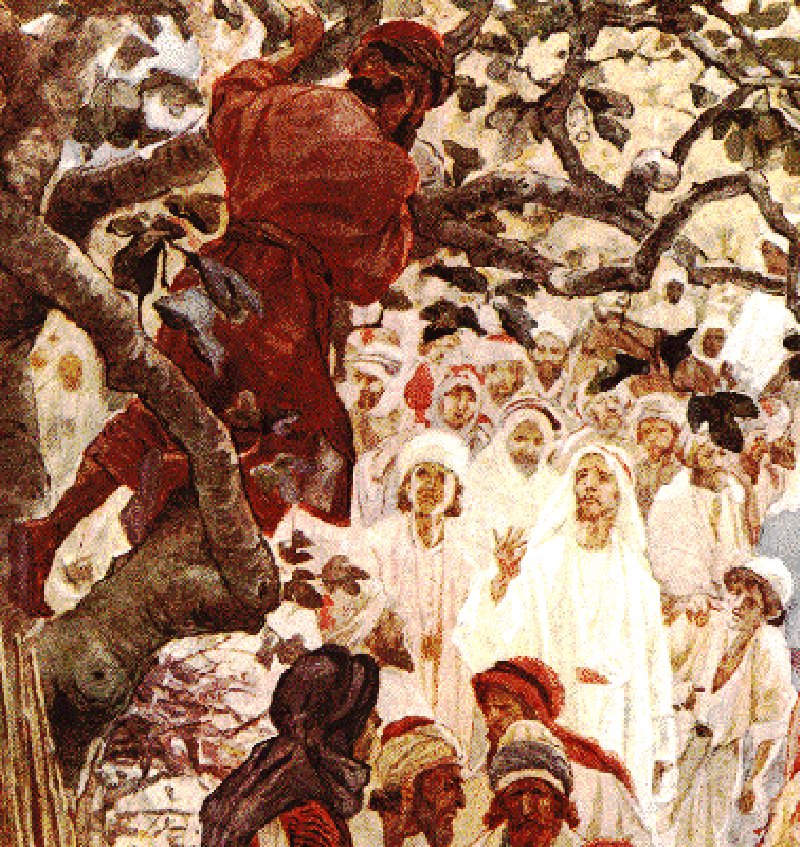
Christ Speaks to Zacchaeus
William Hole, 1908
My dear friends,
Today's narrative from the Gospel of Luke begins as Jesus is passing through Jericho on the road up to Jerusalem for his climactic confrontation with civil, religious, and military powers.
and was passing through it.
A man was there named Zacchaeus;
he was a chief tax collector and was rich.
- Luke 19:1-2
Zacchaeus is caught up in the same nexus of worldly power that will soon be swirling around Jesus in Jerusalem. By collecting taxes for the Roman occupying forces, and by raking off some of the proceeds for himself, he is despised by his fellow Jews.
but on account of the crowd he could not, because he was short in stature.
So he ran ahead and climbed a sycamore tree to see him,
because he was going to pass that way.
- Luke 19:3-4
Here we may see a profound prefiguration: The tree that Zacchaeus must climb to see his own salvation is symbolic of the cross on which Jesus will be lifted up to become, as he prophesied, "a ransom for many." (Mark 10:45)
"Zacchaeus, hurry and come down, for I must stay at your house today."
So he hurried down and was happy to welcome him.
- Luke 19:5-6
The Buddha-nature within all beings is always known to the Awakened Ones. Jesus sees Zacchaeus not merely as a tax collector, but as a home ready to receive the Dharma. His call, urgent and personal, is the voice of the Awakening Mind of bodhicitta that seeks no delay in reaching beings with the medicine of love and truth. Zacchaeus' joy in receiving him reflects a karmic readiness and the opening of the heart center, the turning of the mind toward the spiritual path.
"He has gone to be the guest of one who is a sinner."
- Luke 19:7
The path of a Bodhisattva runs contrary to the logic of the world. Where worldly beings recoil from impurity, the bodhisattva enters in to benefit those most forsaken. The crowd's grumbling mirrors our own conditioned judgments, which the bodhisattva learns to recognize as delusions of separateness. Jesus’ actions here come from the "divine abode" (brahmavihara) of immeasurable equanimity, loving all without exception, and serving without fear of gossip.
"Look, half of my possessions, Lord, I will give to the poor,
and if I have defrauded anyone of anything, I will pay back four times as much."
- Luke 19:8-9
When the Dharma truly touches the heart, it naturally expresses itself in compassionate action. Zacchaeus’ vow of restitution is a movement of purification. His renunciation of wealth and his willingness to repair harm mark a turning of the wheel of karma in his life. This moment is not just personal redemption, but a planting of the seeds of liberation in the lives of many.
because he, too, is a son of Abraham.
For the Son of Man came to seek out and to save the lost."
- Luke 19:10-11
Salvation is the awakening of the heart to its true nature: emptiness inseparable from compassion. Zacchaeus' house has become a pure land, sanctified not by rituals but by the presence of love, compassion, and wisdom. Jesus, the ultimate embodiment of the Awakened Mind, seeks the lost not with condemnation but with a fearless, all-embracing love. Let us too become vessels of such salvation, bearing the awakening mind into every corner of this suffering world.
Beloved, may the story of Zacchaeus inspire us to climb whatever tree is needed to behold the face of wisdom, to welcome the Teacher into our hearts with joy, and to commit ourselves to the redemptive work of love and justice. May we always remember that even the most hardened beings carry the seed of Buddhahood, waiting only for the gaze of compassion to awaken them.