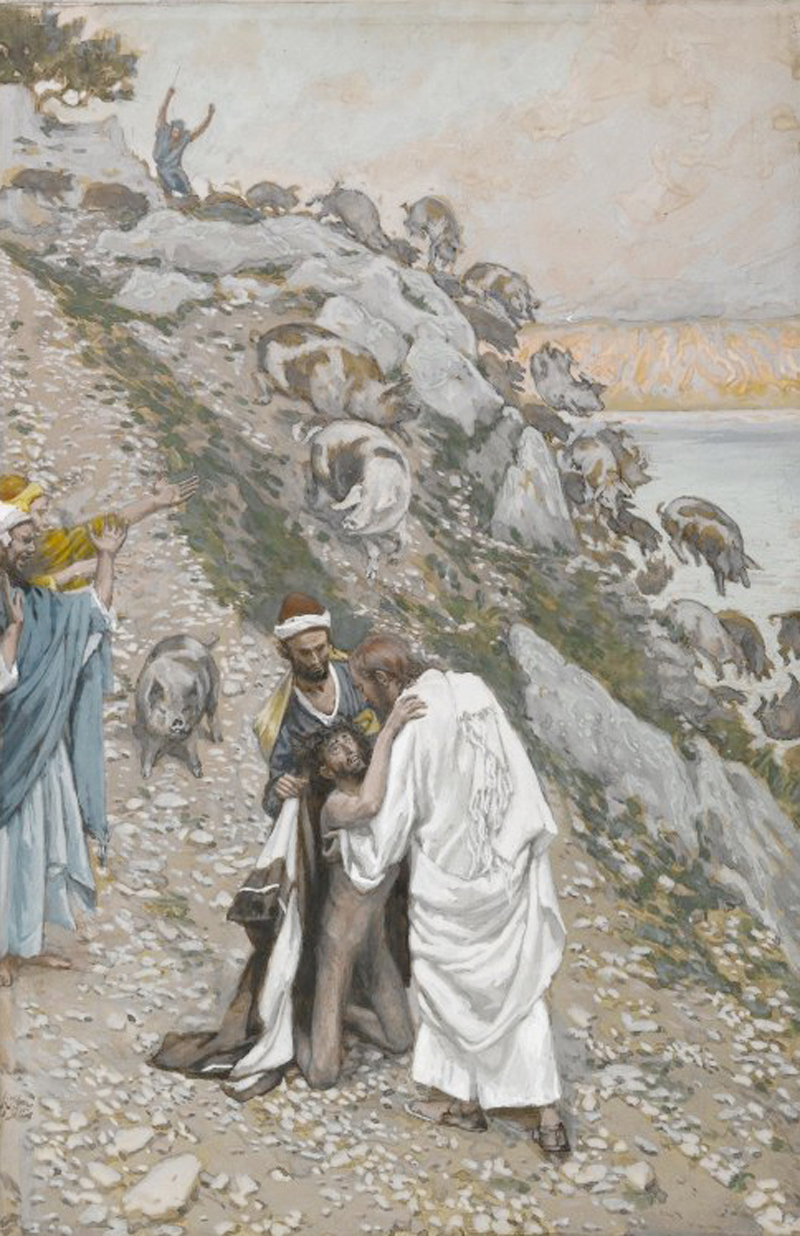
Jesus, the Gerasene, and the Unclean Spirits
James Tissot, 1890
My dear friends,
In Luke 8:26-39, we encounter the account of the "Gerasene demoniac". It is important to appreciate the multiple layers of symbolism embedded in this story.
at the region of the Gerasenes,
which is opposite Galilee.
As he stepped out on shore,
a man from the city who had demons met him.
For a long time he had not worn any clothes,
and he did not live in a house but in the tombs.
When he saw Jesus,
he cried out and fell down before him,
shouting, at the top of his voice,
"What have you to do with me,
Jesus, Son of the Most High God?
I beg you, do not torment me,"
for Jesus had commanded the unclean spirit
to come out of the man.
(For many times it had seized him;
he was kept under guard
and bound with chains and shackles,
but he would break the bonds
and be driven by the demon into the wilds.)
Jesus then asked him, "What is your name?"
He said, "Legion," for many demons had entered him.
- Luke 8:26-30
From a political perspective, the demon-possessed man symbolizes the nation of Israel, which, at the time, was occupied by the Roman legions (a legion comprised approximately 5000 soldiers). The name of the demon, "Legion," reveals a hidden double metaphor: the Roman legions were a force possessing the land, just as the mind of the man was possessed by afflictive thoughts and emotions (kleshas in Buddhist terminology).
Now there on the hillside a large herd of swine was feeding,
and the demons begged Jesus to let them enter these.
So he gave them permission.
Then the demons came out of the man and entered the swine,
and the herd stampeded down the steep bank into the lake and was drowned.
- Luke 8:31-33
Similarly, the herd of swine, considered unclean animals in Jewish tradition, symbolizes the foreign practices of the occupying forces, for instance polytheistic worship. When the demons are cast out and run into the lake, it is a symbolic echo of the Red Sea narrative in Exodus 14:19-31, where the forces of oppression are drowned, hence a symbol of the desire to drive back the forces of occupation into the sea.
Now the Gerasene demoniac, once healed, is found clothed and in his right mind, and becomes a witness to Christ among his own people. This transformation mirrors the spiritual journey that each of us must undertake – from a state of inner turmoil and fragmentation to one of wholeness, integration and service. This theme is echoed in Paul's letter to the Galatians, where he speaks of the transformation that occurs when we clothe ourselves with Christ:
Therefore the law was our disciplinarian until Christ came, so that we might be justified by faith.
But now that faith has come, we are no longer subject to a disciplinarian,
for in Christ Jesus you are all children of God through faith.
As many of you as were baptized into Christ have clothed yourselves with Christ.
There is no longer Jew or Greek, there is no longer slave or free, there is no longer male and female;
for all of you are one in Christ Jesus.
- Galatians 3:23-29
Paul's message is revolutionary. It tells us that regardless of our background, ethnicity, or social status, we are all one in Christ Jesus.
These two contexts tell us, first, that it is important to recognize the forces that occupy and oppress us, whether they be external, such as socio-political forces, or internal, such as negative thoughts, emotions, and habits. It is only through acknowledging these forces and actively working to transform them that we can experience true liberation.
And second, the journey from fragmentation to wholeness is a journey that each of us must undertake. It requires us to clothe ourselves with Christ, or in other words, to embody the qualities of love, compassion, and wisdom that Christ represents. By doing so, we can become witnesses to Christ, as the healed demoniac did, and contribute to the healing and transformation of our world.
May peace and blessings be upon you all.