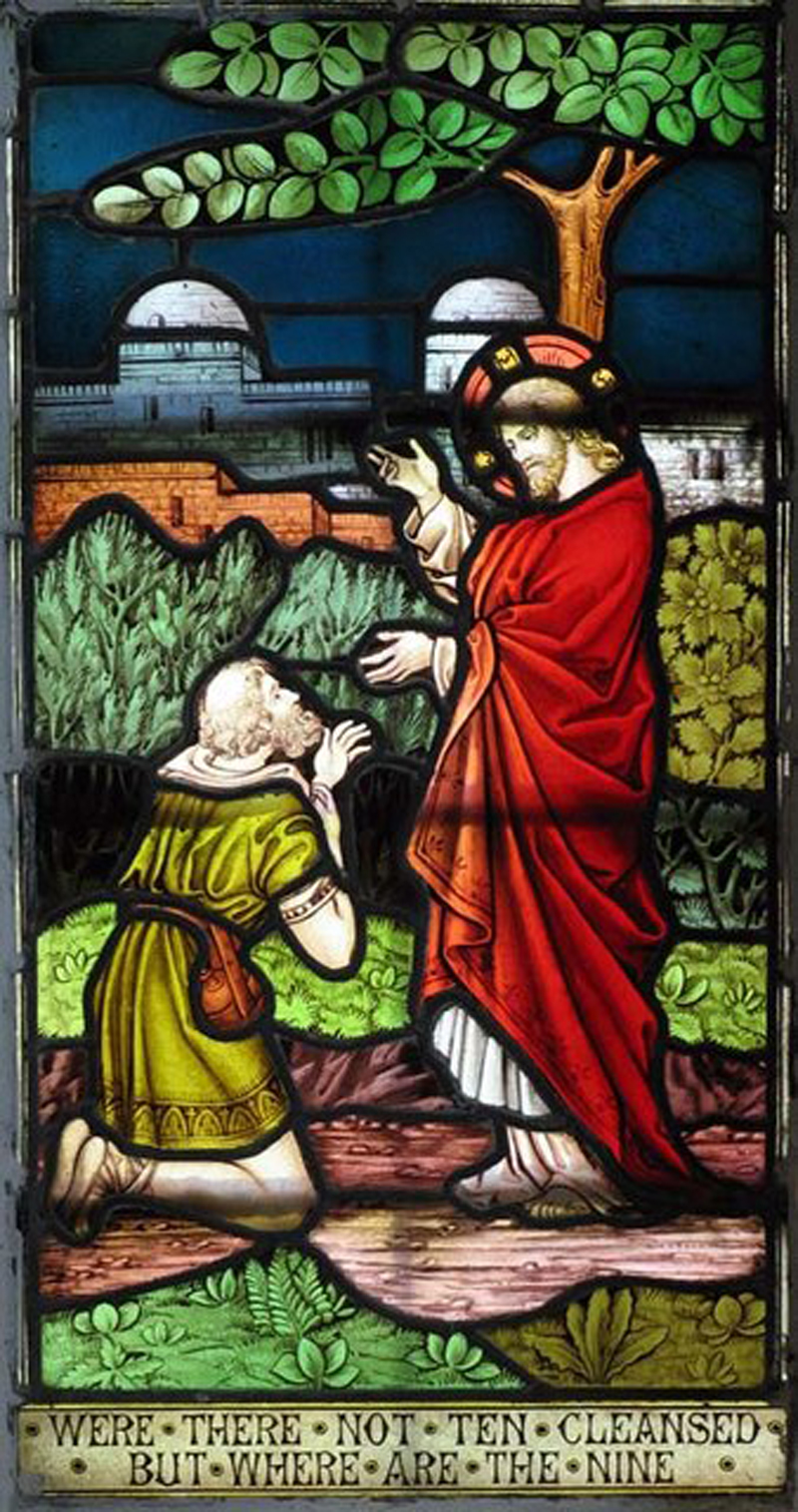
Christ with the Grateful Samaritan Leper
St. Andrew's Church, Buckland, UK, 20th century
My dear friends,
Today's reading is a lesson on healing, gratitude, and faithfulness:
Jesus was going through the region
between Samaria and Galilee.
As he entered a village,
ten with a skin disease approached him.
Keeping their distance, they called out, saying,
"Jesus, Master, have mercy on us!"
When he saw them, he said to them,
"Go and show yourselves to the priests."
And as they went, they were made clean.
Then one of them, when he saw that he was healed,
turned back, praising God with a loud voice.
He prostrated himself at Jesus's feet and thanked him.
And he was a Samaritan.
Then Jesus asked, "Were not ten made clean?
So where are the other nine?
Did none of them return to give glory to God
except this foreigner?"
Then he said to him,
"Get up and go on your way;
your faith has made you well."
- Luke 17:11-19
Let us consider this story from the perspective of this lojong ("mind transformation") teaching:
- Geshe Chekawa, Mind Training in Seven Points (2.9)
This advice is not sentimental. It is a powerful antidote to self-absorption and spiritual blindness.
The one healed man is a Samaritan, doubly marginalized by his disease and his religious practices. Yet he is the only one of the ten who recognizes the grace he has received and turns back in body, speech, and mind: He praises God with his voice, prostrates his body before Jesus, and gives thanks. This gesture reveals faithfulness born from gratitude, and more deeply, the recognition of profound interdependence: he knows he did not heal himself. He received a kindness unearned and unrepayable. His return is not just etiquette; it is awakening.
The others were healed bodily but remained spiritually dull. Their lack of response to grace is the fruit of a heart still enclosed in self-concern.
Geshe Chekawa’s instruction points us to a central insight: our very existence is cradled in the kindness of others. Parents, teachers, friends, strangers, even those who challenge us, each are agents of our formation. In this sense, all beings have been as kind to us as Jesus was to the ten lepers. Yet, like the nine, we often go on our way, healed by the world’s mercy, yet forgetting to turn back in gratitude.
To “meditate on the great kindness of all” means to remember actively rather than passively. It is a form of spiritual return: to face, to bow, to give thanks. This is not weakness but the rising of bodhicitta, the mind that sees others not as means, but as beloved companions in the great journey toward freedom.
In the end, Jesus says to the one, “Your faith has made you well.” Not merely healed, but made well. His wellness is full: gratitude has opened him to the deeper reality. He is not just cured in body, but awakened in spirit.
Likewise, when we train in lojong, when we remember the kindness of others, we are not simply being polite. We are aligning our hearts with the awakened mind. We are practicing faithfulness. We are being made well.