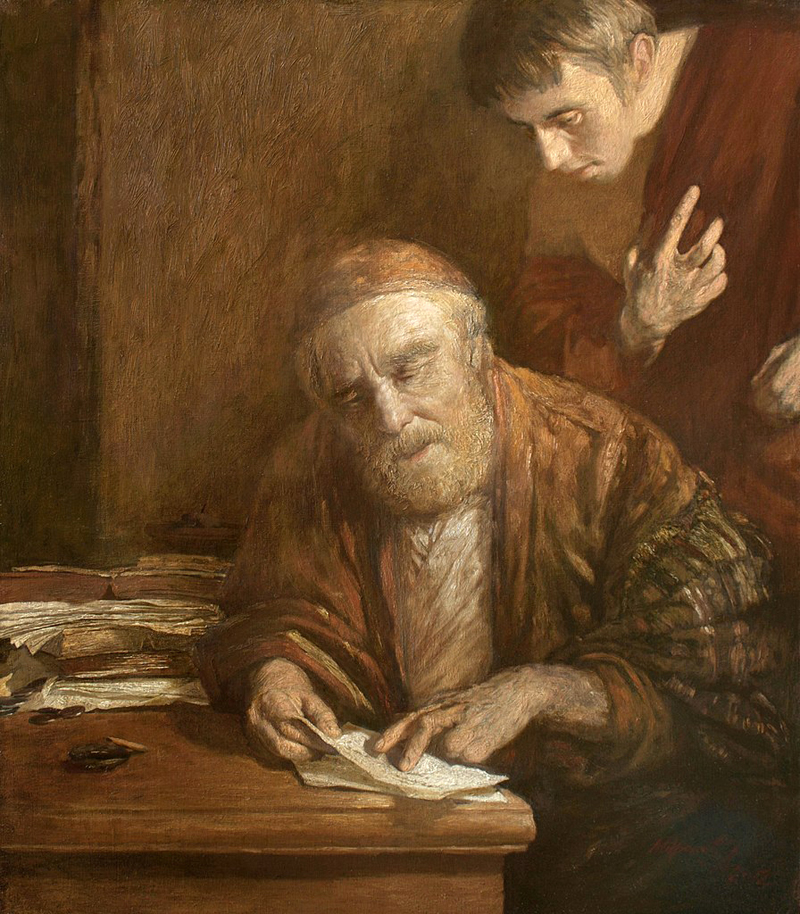
Parable of the Unjust Steward
Andreĭ Nikolaevich Mironov, 2012
My dear friends,
The parable of the dishonest manager in Luke 16:1-13 challenges both our moral instincts and our spiritual understanding. Yet beneath the surface lies a rich teaching on impermanence, accountability, and the wise use of resources for higher ends. Seen from the Bodhisattva path, where wisdom and compassion guide us, it becomes a profound lesson in transforming worldly conditions into causes of awakening.
"There was a rich man who had a manager,
and charges were brought to him
that this man was squandering his property.
So he summoned him and said to him,
'What is this that I hear about you?
Give me an accounting of your management
because you cannot be my manager any longer.'
- Luke 16:1-2
This summons represents the great truth of impermanence and karmic accountability. Just as the manager is called to give account, so too are we—at death, or even within this life—brought face to face with the consequences of our choices. The rich man, like the law of karma, does not punish arbitrarily but reveals the truth of our stewardship. The Bodhisattva reflects deeply on this: how have I used my body, speech, and mind? Have I worked for the benefit of others, or squandered this precious human life?
'What will I do, now that my master is taking the position away from me?
I am not strong enough to dig, and I am ashamed to beg.
I have decided what to do
so that, when I am dismissed as manager, people may welcome me into their homes.'
- Luke 16:3-4
Here arises the spiritual urgency that drives transformation. The manager is not yet awakened, but his crisis gives birth to insight. He begins to seek a way not merely to survive, but to connect with others. On the Bodhisattva path, this is the first spark of bodhicitta, the desire to benefit others, emerging from the recognition of one's own vulnerability and interdependence. We begin to walk a new path not because we are strong, but because we recognize we cannot proceed on the old one.
He answered, 'A hundred jugs of olive oil.
' He said to him, 'Take your bill, sit down quickly, and make it fifty.'
Then he asked another, 'And how much do you owe?' He replied, 'A hundred containers of wheat.'
He said to him, 'Take your bill and make it eighty.'
- Luke 16:5-7
The manager's actions reveal a shift from self-serving squandering to compassionate generosity, albeit imperfectly expressed. In forgiving part of the debts, he lightens the burdens of others. This is a teaching in skillful means (upāya): even worldly resources such as wealth, position, or influence, can be turned toward virtuous ends. The Bodhisattva learns to use samsara itself as the ground for awakening, not through withdrawal alone but through creative, compassionate engagement.
for the children of this age are more shrewd in dealing with their own generation
than are the children of light.
And I tell you, make friends for yourselves by means of dishonest wealth
so that when it is gone they may welcome you into the eternal homes."
- Luke 16:8-9
Jesus praises not the dishonesty but the clarity and decisiveness of one who acts with foresight. The 'children of light' (those who aspire to spiritual truth) must also be wise in how they use worldly means. The instruction to “make friends with dishonest wealth” urges us to use all circumstances, however "impure", to cultivate connection, generosity, and compassion. This aligns with the Bodhisattva vow to transform every situation into the path, turning samsaric fuel into spiritual fire.
and whoever is dishonest in a very little is dishonest also in much.
If, then, you have not been faithful with the dishonest wealth,
who will entrust to you the true riches?
And if you have not been faithful with what belongs to another,
who will give you what is your own?"
- Luke 16:10-12
This speaks to the importance of ethical discipline, the first of the three higher trainings. In the Bodhisattva path, integrity in the smallest actions is the ground for realizing ultimate truth. If we cannot be trustworthy with mundane affairs, how can we be trusted with the subtle, precious Dharma? Thus we train in mindfulness, truthfulness, and care, not only as moral duty but as preparation for holding the wisdom of emptiness and the heart of great compassion.
for a slave will either hate the one and love the other
or be devoted to the one and despise the other.
You cannot serve God and wealth."
- Luke 16:13
This final verse is the cutting edge of renunciation. One cannot serve both the path of egoic grasping and the path of liberation. The Bodhisattva must make a profound inner choice to dedicate one's life to the benefit of all beings, not to personal comfort or accumulation. To serve God or Dharma is to serve the truth of interconnectedness, compassion, and wisdom. It is to walk the path not of dual allegiance, but of undivided heart.
My beloved, this parable does not justify deceit, but it reveals that even in our confused and compromised states, there is a path forward. The manager’s cunning becomes a parable of spiritual strategy: if even worldly minds can act wisely when faced with loss, how much more should those who seek liberation act with urgency, creativity, and compassion. Let us be faithful in the small things, wise in the use of what is fleeting, and devoted wholly to that which endures: the path of love, the heart of awakening, the mind of Christ which is bodhicitta.