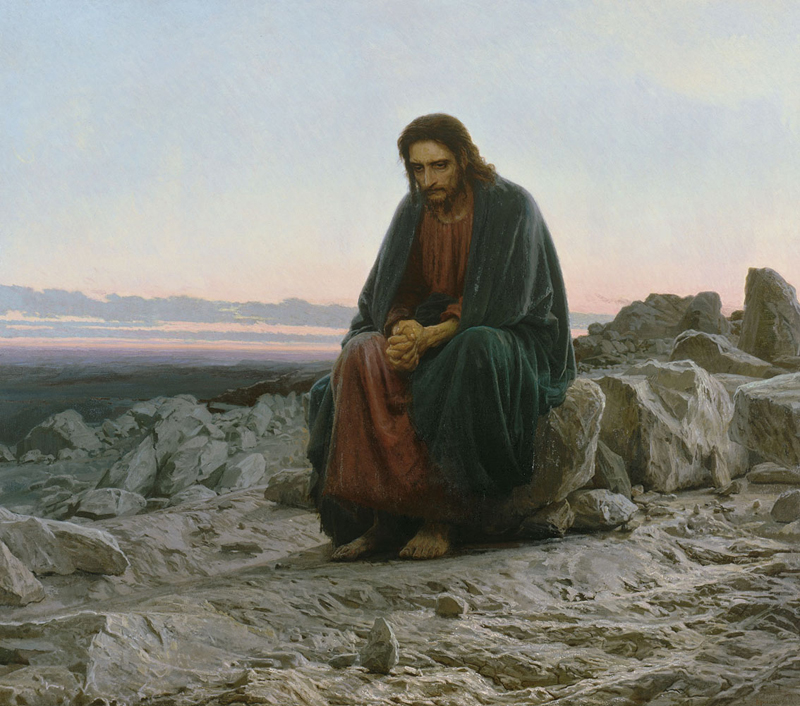
Christ in the Wilderness
Ivan Nikolaevich Kramskoĭ, 1872
My dear friends,
On this first Sunday in Lent, the Gospel sets before us the pattern of the spiritual life as Jesus himself lived it. First, he receives his identity as the Beloved of God in baptism. Then, driven by the Spirit of love, he enters the wilderness where the heart is tested and purified. Finally, he returns to the world bearing not a private triumph but the good news of God’s nearness for all. This is not the story of a solitary hero, but the unfolding of bodhicitta, the union of compassion and wisdom that turns even solitude and struggle into a gift for others.
and was baptized by John in the Jordan.
And just as he was coming up out of the water,
he saw the heavens torn apart
and the Spirit descending like a dove upon him.
And a voice came from the heavens,
"You are my Son, the Beloved;
with you I am well pleased."
- Mark 1:9-11
At his baptism, Jesus receives the confirmation of his deepest identity: belovedness. The heavens are torn open, showing that the ordinary and the divine are not two separate realms. In Buddhist terms, this moment reveals the presence of Buddha nature, the luminous seed already present within us. Yet this is not "a thing to be exploited" (Ephesians 2:6). It is the foundation of a mission. Just as bodhicitta arises when we see that our awakening must benefit all beings, so the Spirit’s descent upon Jesus is the empowerment to live entirely for others.
- Mark 1:12
Notice the urgency: the Spirit drove him out. Love is not passive. Relative bodhicitta—the motivation to awaken for the sake of all—compels us into the very places we would rather avoid. The wilderness is the ground where distractions fall away and where self-centeredness must be confronted. Without this driving force of compassion, solitude would collapse into escapism. But when the Spirit of love propels us, the wilderness becomes the training ground of the heart.
and he was with the wild beasts, and the angels waited on him.
- Mark 1:13
The wilderness holds both terror and grace. Forty days recalls Israel’s forty years in the desert, a time of purification. Jesus meets the adversary, the embodiment of temptation and delusion. Yet he also meets wild beasts and angels—the raw forces of nature and the gentle messengers of God. So too in meditation: the mind presents both our demons and our supports. The point is not to escape but to remain, learning patience, humility, and trust. This is how the seed of Buddha nature is watered and begins to grow toward its full flowering.
proclaiming the good news of God, and saying,
"The time is fulfilled, and the kingdom of God has come near;
repent, and believe in the good news."
- Mark 1:14-15
From baptism to wilderness to mission—this is the arc. Jesus emerges not withdrawn, but proclaiming. The testing has purified his heart so that he can now offer the good news with authority. The kingdom of God is near, not because heaven has descended from elsewhere, but because when the heart awakens in love and wisdom, the kingdom becomes visible here and now. “Repent” means to turn—to shift from self to others, from delusion to truth. In Buddhist language, it is the arising of bodhicitta, the union of love, compassion and wisdom.
As we begin our Lenten journey, we are not called to heroic striving or private perfection. We are called to remember our true identity as beloved of God, to let the Spirit of compassion drive us into the wilderness where selfishness is loosened, and to return with hearts made spacious for others. Lent is a season of awakening bodhicitta: cultivating love and wisdom so that our prayer, fasting, and generosity become nourishment for the whole world. If we walk this path with Jesus, our solitude will ripen into compassion, and our testing into tender service, until our very lives proclaim the good news: the kingdom of God is near.