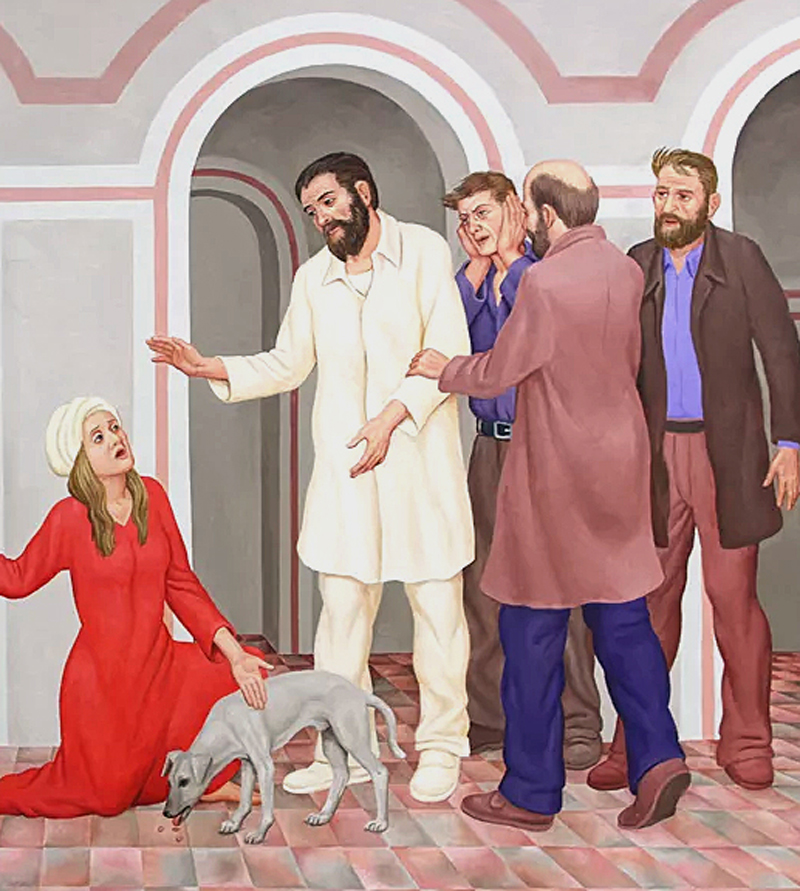
The Daughter of the Canaanite Woman
Peter Koenig, 2016
My dear friends,
The encounter between Jesus and the Canaanite woman is among the most surprising and profound in the Gospels. At first glance, Jesus appears to refuse her plea, yet by the end of the story he praises her with words spoken to almost no one else: "Great is your faith!" Read within the larger story of Scripture, this encounter reveals the unfolding fulfillment of God's covenant with Abraham. Israel was chosen so that all the families of the earth might be blessed through her. Jesus begins his ministry by gathering the lost sheep of Israel, for the covenant must be honored before it can overflow to the nations. The Canaanite woman's faith becomes a sign that the promised blessing has already begun to extend beyond the boundaries of Israel, preparing the way for the risen Christ's command to make disciples of all nations.
Just then a Canaanite woman from that region came out and started shouting,
"Have mercy on me, Lord, Son of David; my daughter is tormented by a demon."
- Matthew 15:21-22
The woman approaches Jesus carrying several burdens at once. She is a foreigner, descended from the ancient enemies of Israel, and she comes bearing the suffering of her daughter. Yet she addresses Jesus as "Lord, Son of David," recognizing in Israel's Messiah the source of mercy for her own family. Faith often begins this way. We discover that another people's promise somehow has room for us. The awakening mind does not ask whether compassion belongs only to one tribe or one religion. It recognizes genuine suffering wherever it appears and seeks healing with humble confidence.
And his disciples came and urged him, saying,
"Send her away, for she keeps shouting after us."
- Matthew 15:23
Jesus' silence is unsettling, and the disciples reveal the narrowness of the ordinary human heart. Their concern is not the woman's anguish but the inconvenience of her persistence. We may recognize ourselves in them whenever another person's need interrupts our plans. The Bodhisattva path invites us to remain present to suffering instead of pushing it away. Sometimes silence precedes revelation, exposing what lies hidden within our own hearts before compassion can be fully awakened.
But she came and knelt before him, saying, "Lord, help me."
- Matthew 15:24-25
Jesus affirms the priority of his mission to Israel. This is no arbitrary preference, for God's covenant with Abraham unfolds through the people of Israel. Yet that covenant always carried a larger purpose: through Abraham, every nation would receive blessing. The woman's response is remarkable because she does not challenge Israel's place in God's saving work. She kneels before Jesus and simply asks for mercy. Her humility reflects the wisdom that divine compassion is never diminished by being shared. She trusts that the Shepherd of Israel possesses love abundant enough to embrace those who stand outside the flock.
She said, "Yes, Lord, yet even the dogs eat the crumbs that fall from their masters' table."
- Matthew 15:26-27
The woman's answer is one of the most beautiful expressions of faith in the New Testament. She does not demand equality, argue her merits, or deny the children's place at the table. Instead, she perceives the superabundance of God's mercy. If the Messiah truly bears the fullness of God's love, then even the crumbs are enough to heal her daughter. Her insight reaches beyond the literal image. The blessing given to Israel does not become smaller when it extends to the nations. Divine generosity grows by being shared. In this moment the woman sees the deeper meaning of the Abrahamic covenant: the table prepared for God's chosen people was always intended to become a feast for the whole world.
Let it be done for you as you wish."
And her daughter was healed from that moment.
- Matthew 15:28
Jesus publicly honors the faith of this Gentile woman, and her daughter is immediately healed. This is far more than an isolated miracle. Matthew places this encounter as a signpost pointing toward the Gospel's conclusion, when the risen Christ sends his disciples to every nation. The Canaanite woman stands at the threshold of that expansion. She embodies the first fruits of the promise that all peoples will be blessed through Abraham's offspring. From the perspective of the Bodhisattva path, her faith also reveals that awakening recognizes no permanent boundary between "us" and "them." Wherever compassion meets receptive faith, healing becomes possible.
As followers of Christ, we are invited to imitate both the woman's steadfast faith and the expanding compassion revealed through this encounter. The Church is healthiest when it remembers that election is a vocation to serve rather than a privilege to possess. Likewise, the Bodhisattva understands that genuine awakening naturally widens the circle of care until every being is included. Whenever we welcome the stranger, listen to the persistent cry of suffering, and trust that God's mercy is greater than our inherited divisions, we participate in the fulfillment of the ancient promise. The table of the Kingdom has become a banquet, and there is bread enough for all.