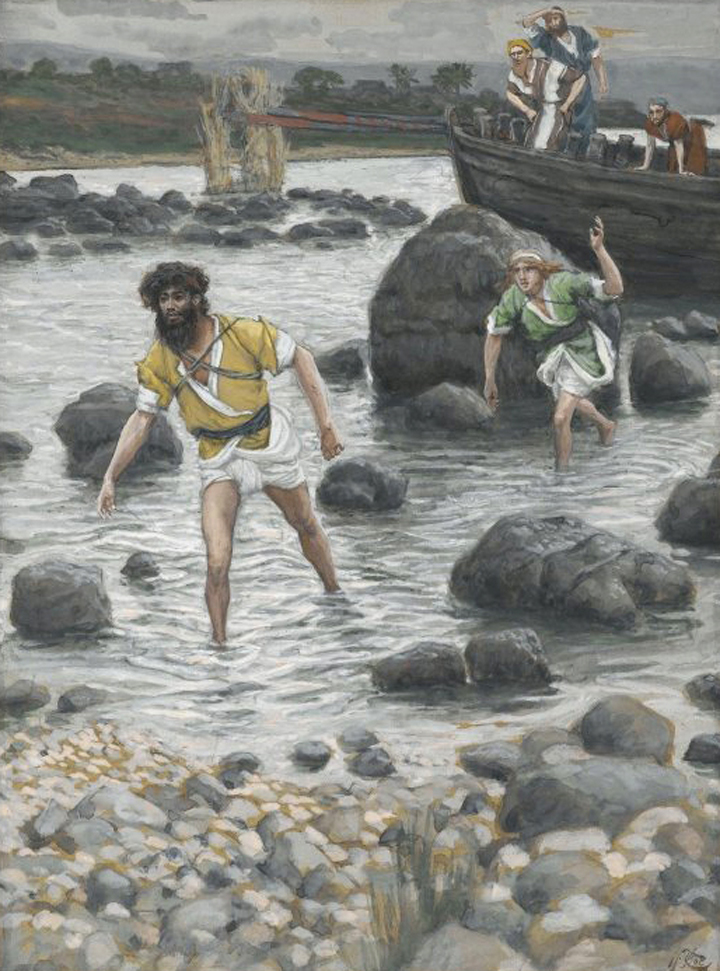
Calling of Saint James and Saint John
James Tissot, ca. 1890
My dear friends,
Matthew 4:12-23, recounting the beginning of Jesus's ministry in Galilee, is a reflection of the Bodhisattva vow in action: Jesus, moved by the suffering of the world, walks forth in compassion, calling beings to repentance and healing.
that John was cast into prison,
he departed into Galilee....
From that time Jesus began to preach, and to say,
Repent: for the kingdom of heaven is at hand.
- Matthew 4:12,17 (KJV)
When the light of one teacher is obscured, another light arises. Jesus goes into Galilee, not in retreat, but as one who understands the time to act has come. His message, "Repent," is none other than the call to turn the mind, to awaken bodhicitta, the mind of love, compassion, and wisdom. As Shantideva has said, all suffering comes from cherishing the self; all happiness from cherishing others. Jesus preaches the kingdom that is realized through this very reversal.
Simon called Peter, and Andrew his brother, casting a net into the sea: for they were fishers.
And he saith unto them, Follow me, and I will make you fishers of men.
- Matthew 4:18,19 (KJV)
To "fish for people" is to draw them up from the waters of ignorance into the air of truth. Jesus sees beyond the worldly trades of Peter and Andrew; he sees their potential to become vessels of compassion. This is the skillful means (upaya) of the awakened ones: they speak in the language of the listener, yet point to the highest path. Just as a Bodhisattva recognizes the karmic readiness of beings, so does Jesus call them at the right moment.
- Matthew 4:20 (KJV)
This verse shows the swift renunciation that arises from deep faith and ripened karma. Just as Milarepa abandoned worldly affairs upon hearing the Dharma, so do these brothers leave their nets. They are exchanging self for others: leaving the livelihood of catching fish to join the work of liberating beings. The nets of karma are dropped in favor of the freedom of the path.
James the son of Zebedee, and John his brother,
in a ship with Zebedee their father, mending their nets; and he called them.
And they immediately left the ship and their father, and followed him.
- Matthew 4:21,22 (KJV)
Followers of the Way do not cease to love their parents, but extend that love to include all beings as their children. James and John follow Jesus immediately, indicating the strength of their karmic connection to the Dharma. Just as the Mahayana teachings say that one who hears the true path and responds instantly has practiced it in many past lives, so their immediate response is a sign of their deep roots in compassion. Their father's name reflects their destiny: in Hebrew, Zebadyah means "the LORD has bestowed."
teaching in their synagogues, and preaching the gospel of the kingdom,
and healing all manner of sickness and all manner of disease among the people.
- Matthew 4:23 (KJV)
The Bodhisattva does not remain in one place, but moves like the wind, bringing benefit wherever beings suffer. Jesus teaches, preaches, and heals — the threefold action of the awakened mind: guiding with wisdom, inspiring with love, and relieving with power. He does not seek his own comfort, but labors for others. This is the union of the three higher trainings: ethical conduct in healing, meditative presence in preaching, and wisdom in teaching the kingdom.
May we, too, arise from our nets and ships, from our habits of self-concern and narrow vision, to follow the teachings and example of the One of Galilee. In his call echoes the eternal call of the Dharma: to love without limit, to serve without pride, and to awaken for the sake of all.
beside the Syrian sea,
the gracious calling of the Lord,
let us, like them, without a word
Rise up and follow Thee.
- John Greenleaf Whittier, Dear Lord and Father of Mankind, verse 2