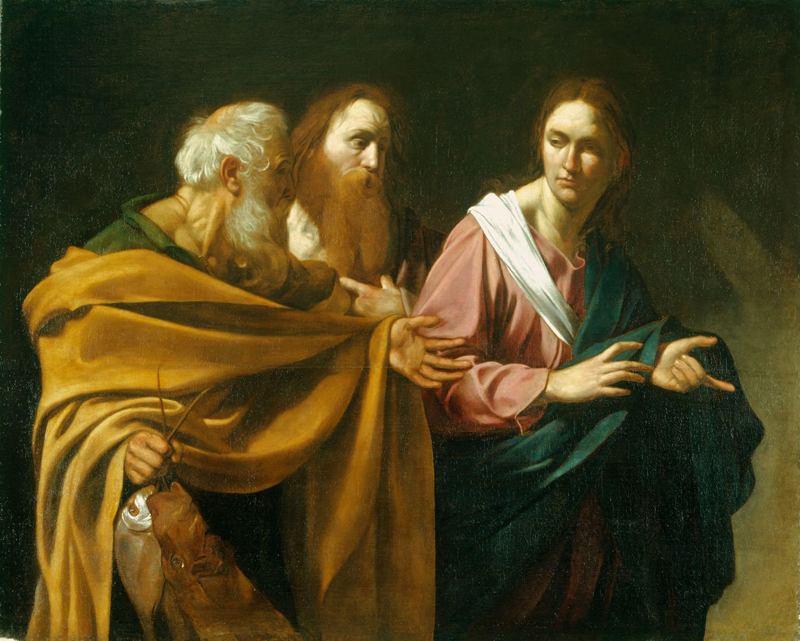
Calling of Saints Peter and Andrew
Michelangelo Merisi da Caravaggio, 1603
My dear friends,
In this season of Epiphany, we continue to contemplate how the divine nature and mission of Jesus are revealed more and more clearly. This unfolding mirrors the gradual path of awakening taught in the Bodhisattva path. As Jesus is recognized, not just as a teacher but as the Lamb of God, we are reminded that true spiritual sight arises through purification, devotion, and the readiness to follow. Just as the light of wisdom dawns progressively in the mind of a bodhisattva, so too does the identity of Jesus come into clearer focus in the hearts of those with eyes to see.
"Here is the Lamb of God who takes away the sin of the world!...."
The next day John again was standing with two of his disciples,
and as he watched Jesus walk by, he exclaimed, "Look, here is the Lamb of God!"
- John 1:29,35-36
The declaration of Jesus as the Lamb of God is not a mere poetic title but a signal of his self-offering nature. On the Bodhisattva path, the ideal is to renounce self-interest and work tirelessly for the liberation of others. John the Baptist, like a spiritual guide, sees in Jesus the very embodiment of this compassionate resolve. Just as a Bodhisattva vows to free all beings from suffering, Jesus appears as one who will take upon himself the burden of the world's sin, not to punish but to heal. To recognize this is to begin the journey of seeing with the eyes of bodhicitta, the "Awakening Mind" of love, compassion, and wisdom.
When Jesus turned and saw them following, he said to them, "What are you looking for?"
They said to him, "Rabbi" (which translated means Teacher), "where are you staying?"
He said to them, "Come and see."
- John 1:37-39a
"What are you looking for?" This question is the very entry point into the path. The Buddha too asked, "What do you seek, monks?" Jesus's reply, "Come and see," is not an offer of easy answers but an invitation into the mystery, the journey, the path. The Way cannot be explained fully in words but must be realized by each seeker through direct experience.
It was about four o'clock in the afternoon.
One of the two who heard John speak and followed him was Andrew, Simon Peter's brother.
He first found his brother Simon and said to him,
"We have found the Messiah" (which is translated Anointed).
- John 1:39b-41
The disciples remained with Jesus. This signifies not mere physical presence but the inner abiding that arises when one encounters the mind of awakening in another. In the path of the Bodhisattva, spiritual friendship and reliance upon a teacher are crucial. Just as disciples of the Buddha would dwell near him to absorb his realization, so Andrew and the other disciple stay with Jesus. Their realization bears fruit in their impulse to share: the awakening mind naturally seeks to bring others onto the path. Andrew’s joy in finding the Anointed mirrors the spontaneous compassion that arises in those who have glimpsed the truth.
"You are Simon son of John. You are to be called Cephas" (which is translated Peter).
- John 1:42
When Jesus renames Simon as Cephas (Petros, "The Rock"), he sees into his deeper nature and future calling. In the Bodhisattva tradition, names and titles are not given lightly but reflect realization and responsibility. This is a moment of empowerment, similar to when a lama confers a new name upon a disciple at ordination or after a significant insight. It marks a turning point: Simon is not only being called but is being entrusted with a role in the unfolding of the great work of liberation. Jesus does not merely see who he is, but who he is to become.
In this passage, the light of Epiphany grows brighter. The Lamb of God is revealed. The first disciples respond and follow. The awakening spreads from one to another. So it is with the path of the Bodhisattva: it begins with seeing, deepens with staying, matures in sharing, and blossoms into a new identity shaped by compassion and truth. May we, too, hear the call to come and see, and may we abide with the Christ until we are transformed into vessels of bodhicitta, radiant with love for all beings.